
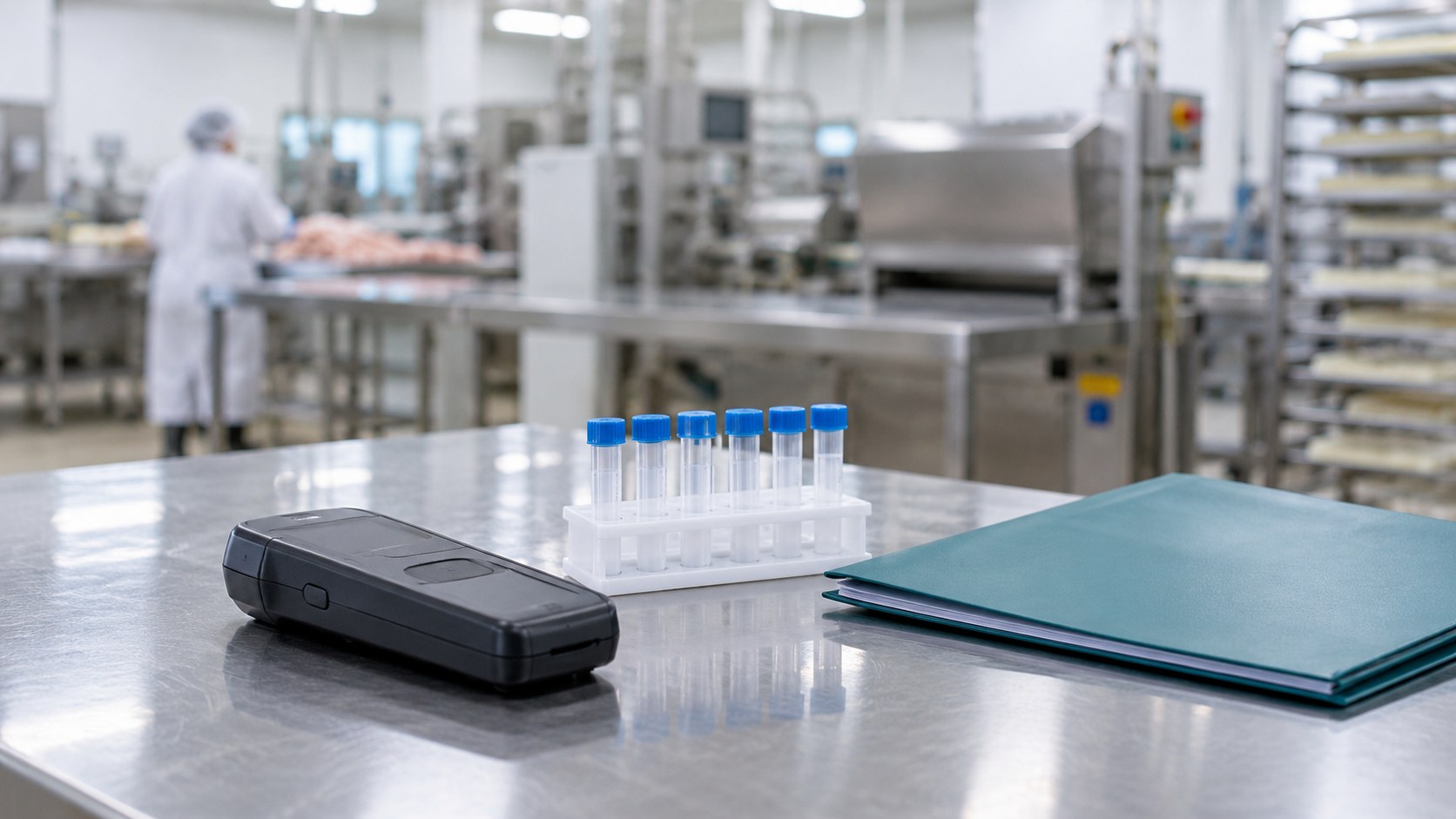
Need help with ATP cleaning-check results and records? Review our food safety and quality consulting or contact AFVA for free initial guidance.
ATP hygiene checks can provide quick cleaning information, but a list of RLU numbers needs context. A change in the device, test point, sampled area or stage of cleaning may change what the results mean. A lower number on a new dashboard does not automatically demonstrate improved cleaning.
This guide helps New Zealand food businesses make routine cleaning-verification data comparable. It focuses on method identity, criteria, records and change review. It supplies no universal RLU threshold, sampling protocol, chemical instruction or product-release decision.
Quick answer: Define the cleaning question, use the correct device and test instructions, identify the exact surface and sampling stage, and retain the basis for your criteria. Compare like with like, preserve original and repeat results, and investigate changes in the method or operation. An ATP result provides hygiene information; it does not identify a particular pathogen or establish allergen clearance.
Define what the ATP check is meant to show
ATP is adenosine triphosphate. ATP surface systems measure a light-producing response associated with ATP in the collected material and commonly report relative light units, or RLUs. That material can include food residues and microbial material. The result does not identify the source as a particular organism.
Chapter8 of the FSANZ July 2025 microbiological-criteria Compendium distinguishes rapid hygiene checks and visual inspection from testing for target microorganisms. Use an ATP check for its defined cleaning question within the wider programme. Keep allergen-specific evidence and any required microbiological work separate. The environmental monitoring programme guide addresses that broader design question.
Write the purpose in the local instruction: which cleaning activity and surface are being checked, at which stage, and what action follows an unacceptable or uncertain result? “Check the factory” is too broad to explain what one reading supports.
Keep the exact test and instrument identifiable
A device and its consumable are a measurement system. Keep the product, instrument model or identifier, relevant test type and current instructions together. Confirm that the consumable is suitable for the intended surface or sample type; do not assume a surface device is also the correct device for rinse water.
For a concrete manufacturer example, Hygiena’s UltraSnap surface-test instructions distinguish the surface application from water testing, specify instrument and test handling, and warn that overloading a swab with visible material can give inaccurate results. These are instructions for that product, not a universal method for every ATP system or an endorsement of one supplier.
Follow your actual system’s controls, storage, expiry, handling and operating instructions. If a control check or device condition is unsatisfactory, investigate it before interpreting a site result as evidence of cleaning performance. This article does not prescribe a calibration schedule or an improvised check.
Make the surface and sampling stage consistent
A site identifier should lead to the same defined surface, rather than a general area such as “mixer”. Describe the point and sampling approach clearly enough for another trained person to reproduce the intended check. Retain relevant differences in access, dismantling, surface condition and the product residue being removed.
State when the sample is taken relative to cleaning, sanitising and production. Neogen’s Environmental Monitoring Handbook, hygiene-monitoring chapter stresses consistent collection timing, technique and test-point location. It also discusses possible interference from sanitiser residues and the need to confirm effects with the manufacturer for the system and chemical involved.
Agree the appropriate stage with the competent reviewer and device/chemical instructions. Do not mix pre-sanitising results with later-stage readings without explaining the difference, or change a required sanitising procedure to make sampling easier. For chemical-concentration checks, use the separate food sanitiser check guide. A prepared-solution reading and a surface ATP result answer different questions.
Keep the reason for the acceptance criteria
Retain the criteria, their source, the system and sites they cover, and who assessed their suitability. Factory defaults or another business’s spreadsheet are starting information to review, rather than proof that the same interpretation applies to your food residues, surfaces and process.
Hygiena’s technical bulletin on lower and upper RLU limits recommends documenting how facility limits are determined and considering the application and surface. Its example settings and calculation approach belong to that manufacturer’s context. This article does not reproduce a cut-off, sample count or formula as a New Zealand rule.
Discuss the evidence needed for useful criteria with competent people and the system supplier. Keep the cleaning process, relevant observations and suitable supporting evidence in that assessment. Do not raise a limit merely to turn repeated poor results into passes, or infer a microbiological acceptance limit from an RLU value.
Build a record that keeps comparisons meaningful
We recommend linking each result to the fields below, using your existing system where it already captures them. The table is an editorial record framework. It does not replace the device instructions or prescribe an official national log.
On a small screen, swipe sideways to view all columns. Keyboard users can focus the table region to scroll horizontally.
Retain the actual reading, not only a coloured pass/fail label. If the record is incomplete, identify what is missing rather than supplying a likely value. A photograph or site map can help identify a location, but it does not establish that the sample was collected in the recorded way.
Connect a concerning result to action and follow-up
Use the response in your applicable cleaning and food-safety procedures. Establish whether the result reflects an observed cleaning problem, a method or device concern, or a question requiring further assessment. Keep relevant equipment or surfaces controlled as the procedure requires while the issue is resolved.
Record the original result, what was found, the action taken and the recheck where applicable. Do not erase the first reading after recleaning. If production has already occurred or another food-safety concern is identified, assess that situation through the appropriate incident and affected-product process; an ATP recheck alone cannot settle it.
Review comparable results by site and relevant operating conditions. Look at repeat concerns and whether actions worked, while checking that the method and criteria remained consistent. A better overall pass percentage can be misleading if difficult sites were dropped or testing moved to a different stage.
Review changes before combining old and new results
Neogen explains that RLU scales from different ATP systems are not interchangeable. Keep old and new systems distinguishable and obtain an appropriate method-transition assessment before treating the datasets as one continuous trend. This guide supplies no cross-instrument conversion or equivalence claim.
Apply the same care when a consumable, surface, cleaning chemical, test point or sampling instruction changes. Identify the change date, reason and its potential effect on interpretation. Ask whether criteria or the comparison period need reassessment. A software chart can join data points even when the underlying evidence does not justify the comparison.
Hypothetical review prompt: a business changes luminometer systems and the next report shows lower RLUs. Keep the results labelled by system and review the method, sites, criteria and operating conditions. The lower values alone establish neither improved cleaning nor that the new instrument is better. This is an illustration, not an AFVA client result.
A routine ATP-result review checklist
- The cleaning purpose and sampling stage are clear.
- The correct system, consumable and current instructions are identifiable.
- The site and intended sampling approach are consistent.
- Relevant device checks and possible interference questions are addressed.
- Criteria have an application-specific basis and version.
- Original results remain linked to actions and rechecks.
- Changes and data limitations are visible before trends are compared.
Common mistakes are comparing raw RLU numbers across systems, treating a default as a legal limit, sampling only the easiest point, changing the sampling stage without recording it, and calling an ATP pass an allergen or pathogen clearance. The allergen cleaning-validation guide explains that distinct evidence question.
Frequently asked questions
What RLU value should every food business use?
No universal value is supplied here. Confirm the actual system, surface, purpose and applicable requirements, and retain a justified basis for the criteria used.
Can we compare readings from two brands directly?
Do not assume they share a scale. Keep systems identifiable and obtain a justified transition or comparison assessment before combining results.
Does a low reading prove there is no pathogen or allergen?
That conclusion does not follow from an ATP hygiene result. Use the relevant hazard-specific assessment and suitable methods for those separate questions.
Should testing always occur after sanitising?
Confirm the appropriate stage and possible interference for the actual system and chemical. Follow the applicable cleaning and sanitising requirements; this guide does not prescribe one stage for every operation.
Prepare a focused cleaning-verification review enquiry
AFVA’s food safety and quality consulting includes reviewing cleaning systems, procedures, records and practical gaps. Bring the cleaning instruction, ATP system and test instructions, site list, criteria basis, representative original records and a specific question about interpretation or comparability. Identify any equipment, chemical or method changes.
Agree the scope and any device-manufacturer or external laboratory input needed. Consulting does not certify the device, approve a cleaning method or guarantee a result. MPI’s consultant guidance explains the separate roles and independence requirements for consultant-written plans or programmes.
Sources and scope
Sources were read on 1 November 2026. Technical guidance and manufacturer examples are identified below; the suggested working records are AFVA recommendations, not official forms.
- FSANZ: Compendium of Microbiological Criteria for Food, July 2025 — Chapter8.1 distinguishes rapid hygiene information from target-organism testing.
- Hygiena: UltraSnap surface-test instructions — Product-specific intended use, handling and limitations; no universal settings adopted.
- Hygiena: lower and upper RLU limits bulletin — Manufacturer context for documenting criteria; no numeric threshold or formula supplied here.
- Neogen: Environmental Monitoring Handbook — Hygiene-monitoring sections4.2–4.8; system scales, timing, interference and comparison considerations.
- FAO/WHO: General Principles of Food Hygiene, CXC 1-1969 — Section11.1 provides the broader cleaning, instruction and effectiveness-review framework.
Need practical support? Contact AFVA to discuss the appropriate next step for your food business.
General information only: Requirements depend on the complete food activities, products, processes, locations and sales model. Use current official guidance and confirm the requirements applying to the specific business before relying on a classification, timeframe or record list.
Need Practical Food Safety Support for Your Business?
Contact us for free initial guidance. We provide practical, plain-English food safety support for New Zealand food businesses across all service areas.
This article provides general information only and is not a substitute for professional advice specific to your situation. Contact us for guidance based on your actual food activities and requirements.