
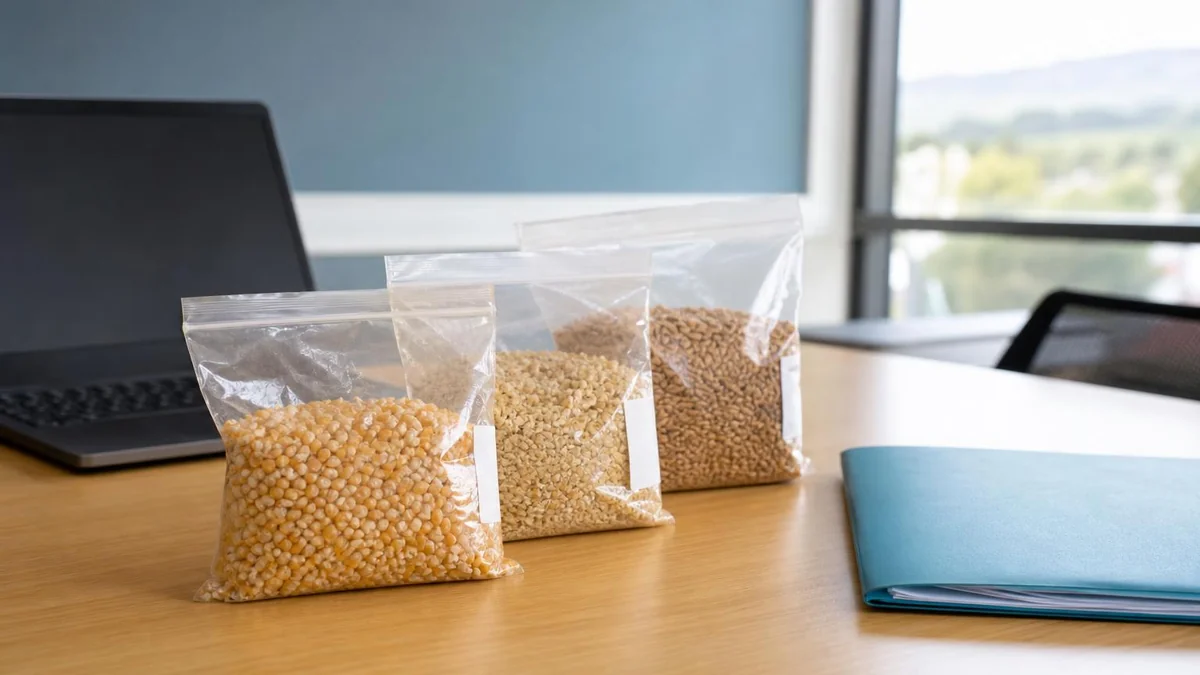
Preparing a grain ingredient testing brief? Explore AFVA’s food safety and quality consulting support or contact AFVA for free initial guidance. The appropriate service and any independence restrictions need to be confirmed before engagement.
A useful cereal testing request describes more than a bag of grain and the words “mycotoxin screen”. Start with the ingredient, the lot you want to assess and the decision the results will support.
This guide helps food manufacturers, ingredient buyers and quality teams prepare that brief. It focuses on grain ingredients for human food, not animal feed, nutrition analysis or a complete shelf-life study. For the wider testing picture, see AFVA’s guide to choosing food tests in New Zealand.
Quick answer: Prepare a brief identifying the grain and ingredient form, supplier and lot, purpose of testing and proposed acceptance criteria. Then agree the analytes, sampling approach, suitable method and reporting requirements with the laboratory before collecting samples. Keep applicable legal limits separate from customer specifications. This is a preparation framework, not a universal testing panel, sampling procedure or testing-frequency rule.
Cereal testing: describe the grain before selecting analytes
Begin by asking which mycotoxins, if any, are relevant to the decision for this ingredient. Obtain the exact name of each substance the laboratory will measure, rather than asking for an undefined screen. FSANZ’s Australian Total Diet Study summaries describe the historical 20th study’s testing of specified foods for aflatoxins and ochratoxin A. Those historical surveys are background, not instructions for testing your current grain lot.
MPI’s chemical hazard and mycotoxin research catalogue also lists research on aflatoxins in maize products, ochratoxin A in cereals and trichothecene mycotoxins in cereal products. The HTML catalogue establishes those research topics; it does not establish a mandatory panel or sampling procedure.
The questions below are practical starting points, not a grain-toxin rulebook. Ask the laboratory or competent adviser to justify the final selection using evidence for your ingredient, origin, supplier history and intended use.
On a small screen, swipe sideways to view all columns. Keyboard users can focus the table region and scroll horizontally.
Request the laboratory’s exact analyte list. Where a specification refers to a total or combined result, ask which substances are included and how that result will be reported.
Identify the lot and prepare a decision-focused brief
Describe the proposed lot before discussing how to sample it. Our recommendation is to link the supplier’s batch reference to your receipt and storage records, rather than identifying the material only by a courier sample number.
If material has been blended, transferred between stores or received in several deliveries, explain that history. Ask whether the proposed grouping is appropriate for the assessment; do not assume one result should cover every delivery.
On a small screen, swipe sideways to view all columns.
Agree sampling before collecting or sending grain
Use the laboratory discussion to establish an approach for the actual lot and intended decision. These are briefing questions, not a validated collection procedure:
- What information is needed about lot size, packaging and access to the material?
- Who should collect samples, and what competence or equipment is needed?
- How many collection points or increments are proposed, and where should they be taken?
- Should samples remain separate or be combined, and what question will each sample answer?
- What total quantity is needed, and who will carry out any grinding, mixing or subsampling?
- What containers, transport conditions and submission records are required?
- What evidence will support treating the submitted samples as representative of the defined lot?
Practical note: Ask for written agreement before collection. Do not adopt a sample quantity from an old research report as your operating procedure. This article deliberately specifies no increment count, sample mass or testing frequency, and does not provide instructions for regulatory border-clearance sampling.
Separate legal limits from customer specifications
The current Food Standards Code Schedule 19: maximum levels of contaminants and natural toxicants specifies limits against particular contaminants and foods. Its aflatoxin entries name peanuts and tree nuts, not cereal grains generally. Do not transfer a nut aflatoxin limit into a grain brief.
Schedule 19 separately lists ergot for cereal grains and defines ergot as the sclerotium, or dormant winter form, of Claviceps purpurea. Keep that definition distinct from a laboratory result for particular ergot alkaloids.
For each proposed acceptance criterion, record:
- Status: applicable legal requirement, customer specification or internal action criterion.
- Source: the exact provision or specification and its current version.
- Scope: the food, ingredient form, analyte or defined sum covered.
- Reporting basis: units and any required basis for expressing the result.
If an applicable numerical limit is unclear, seek a product-specific assessment rather than recording an automatic pass. Ask the laboratory whether its reporting capability is suitable for the proposed criterion and whether it is reporting measurements only or also a compliance opinion.
Pre-submission checklist
- Name the grain, ingredient form and intended use.
- Define the lot and connect it to supplier, receipt and storage records.
- State the decision the evidence must support.
- Review relevant existing evidence before deciding what additional work is needed.
- Agree the analyte list and record why it fits the question.
- Agree sampling, preparation and transport in writing.
- Confirm method suitability and reporting requirements.
- Identify and correctly label each acceptance criterion.
- Nominate the reviewer and keep the brief, sampling records, report and decision rationale together.
Common mistakes to avoid
- Ordering an unnamed “full screen”. Obtain the exact analyte list and compare it with the question.
- Leaving the lot undefined. Specify what the proposed assessment includes and excludes.
- Collecting first and discussing sampling later. Agree the approach before preparing the submission.
- Calling a buyer specification “the NZ legal limit”. Keep the source and status visible.
- Recording a pass without reviewing the report. Check lot identity, sampling history, analytes and reporting capability against the agreed criteria.
Frequently asked questions
Does every grain lot need the same mycotoxin panel?
This guide does not prescribe one. Ask for a justified selection for the grain, ingredient form, source evidence and intended decision, while separately confirming any applicable testing requirements.
How much grain should I send?
Ask the laboratory before collection. Provide the lot description and intended assessment so it can agree collection quantities, preparation and submission requirements. No universal quantity is specified here.
Can I use my supplier’s certificate of analysis?
Review whether it relates to the relevant ingredient and lot, covers the required analytes and provides suitable sampling and reporting information. Identify any evidence gap before commissioning additional analysis.
What does “not detected” or “below LOQ” mean?
Ask the laboratory to explain the wording and reporting limits for its method. Check whether the reported information supports a decision against your agreed criterion rather than assigning your own interpretation.
How often should cereal testing be repeated?
This brief does not set a frequency. Establish any prescribed requirements first, then document the rationale for your business’s evidence and monitoring approach.
Can historical MPI research tell me whether this batch passes?
Use it as background, not as a batch decision. Prepare the assessment around the current ingredient, defined lot, applicable criteria and evidence available for that decision.
How AFVA can help prepare the next step
AFVA’s testing support includes risk-based testing planning, laboratory coordination and result review. Its food safety and quality consulting service can be discussed alongside your product information, records and evidence needs. Laboratory analysis should be arranged with a suitable external laboratory; this is not an offer of AFVA laboratory testing.
Consulting and recognised verification are separate functions. MPI’s guidance on hiring a food consultant states that a consultant who writes a plan or programme cannot evaluate or verify the plan or programme they created. AFVA needs to confirm service scope, independence and conflicts of interest before accepting work; this consulting enquiry is not an offer of a conflicting verification engagement.
Have the ingredient details but need a clearer brief? Contact AFVA to discuss appropriate testing-planning support. Bring the grain description, lot references, existing reports and the decision you need to make.
General information only: Requirements depend on the complete food activities, products, processes, locations and sales model. This article provides briefing questions, not a validated sampling protocol, a mandatory testing panel or a batch-release decision. Use current official guidance and confirm the requirements applying to the specific business before relying on a classification, timeframe or record list.
Need Practical Food Safety Support for Your Business?
Contact us for free initial guidance. We provide practical, plain-English food safety support for New Zealand food businesses across all service areas.
This article provides general information only and is not a substitute for professional advice specific to your situation. Contact us for guidance based on your actual food activities and requirements.