
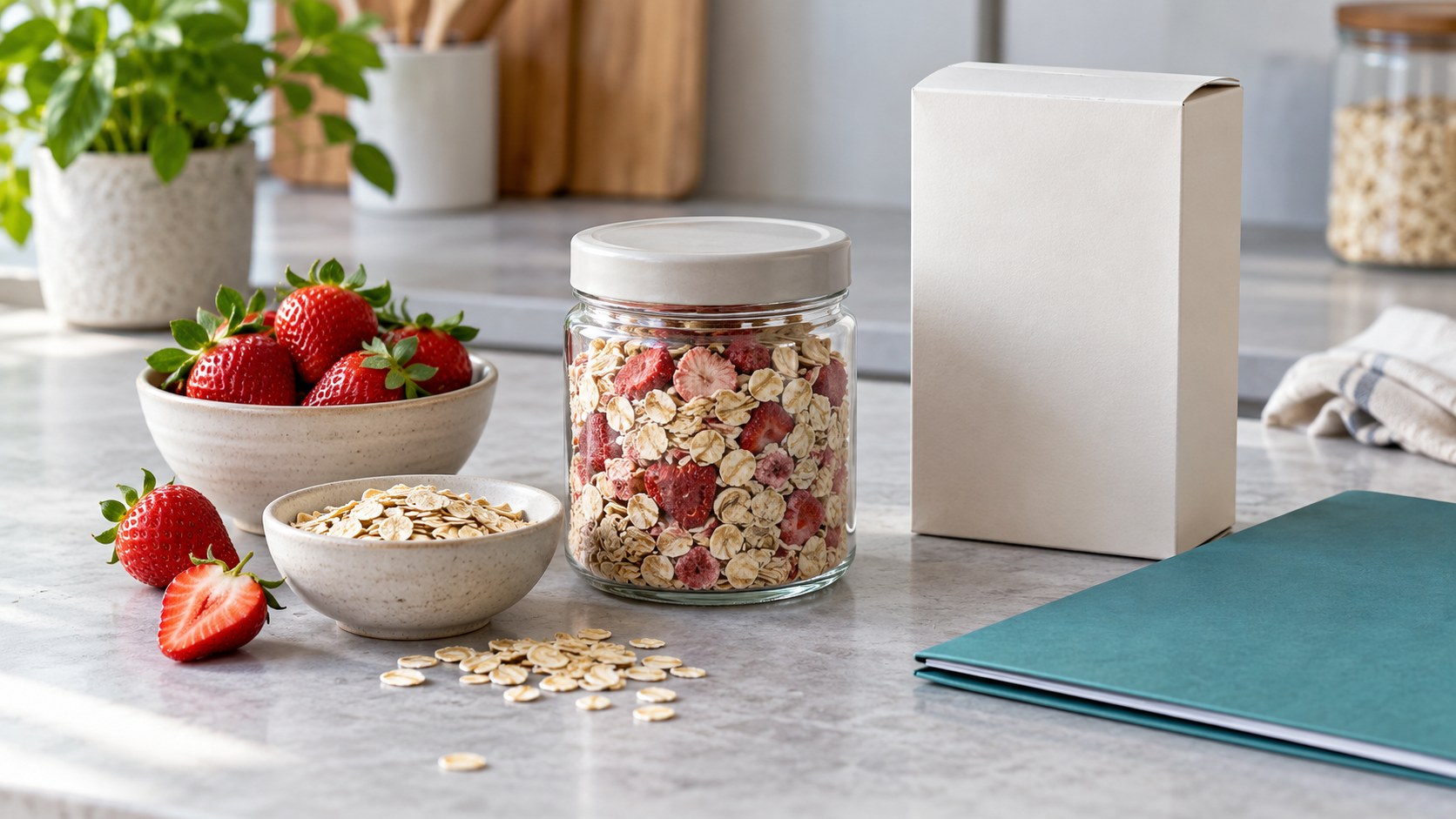
Need help with characterising ingredients and percentage labelling? Review our food labelling review service or contact AFVA for free initial guidance.
Putting strawberries in a product name or showing them prominently on a pack can create a percentage-labelling question. The decision starts with what the label tells the purchaser about the food, then follows through to the relevant ingredient, calculation and declaration.
This guide is for New Zealand food brands, manufacturers and importers reviewing ordinary retail food labels. It focuses on characterising ingredients and components. It does not replace the full ingredients list, allergen assessment, nutrition panel or separate nutrition and health claim checks.
Quick answer: Check whether an ingredient, ingredient category or component meets the Code’s characterising definition, then check the exclusions and any food exemption. Where a declaration is required, calculate it on the applicable basis and identify whether it is actual, minimum or an allowed panel quantity. A picture does not remove the need to assess the definition and exceptions.
In this guide
- Identify what the label characterises
- Check exclusions and exemptions
- Choose the correct calculation basis
- Work through a simple example
- Transfer the supported declaration to artwork
- Percentage-labelling review checklist
- Frequently asked questions
- Practical AFVA label-review support
- Official sources and review date
Identify what the label characterises
Standard 1.1.2, section 1.1.2—4 identifies three starting triggers: the ingredient or component is named in the food’s name, consumers usually associate it with that name, or the label emphasises it through words, pictures or graphics. Review the whole consumer presentation rather than the ingredients panel alone.
Make a short list of the ingredients, ingredient categories and components that the presentation brings forward. Keep the exact product name, highlighted text and relevant images alongside that list. The artwork version matters: adding an ingredient photograph after the technical review can reopen the percentage decision.
An ingredient is not the same concept as a component. An ingredient category can group relevant ingredients, while a component is a constituent present in the food. FSANZ’s ingredient-list and percentage-labelling guidance uses strawberries in strawberry yoghurt as an ingredient example and cocoa solids in chocolate as a component example. Identify which thing your proposed number actually describes.
Mandatory information does not, by itself, count as emphasis under this definition. Naming an ingredient because the Code requires it is therefore different from deliberately promoting that ingredient across the front of the pack. Consider the complete presentation before making the decision.
Check exclusions and exemptions before calculating
The definition excludes an ingredient or category used in small amounts to flavour food, one that makes up the whole food, and a defined category of named ingredients whose amount does not govern consumer choice or distinguish the food. Apply the actual conditions; do not create a percentage threshold of your own for the words “small amounts”.
Standard 1.2.10, section 1.2.10—3 also exempts specified foods from this characterising-information requirement. The list includes prepared filled rolls and similar products, qualifying small packages, and certain other categories such as whole-cut cured or dried meat. This is not a universal exemption for products containing those foods as ingredients.
If the proportion of a characterising component is declared in accordance with the Standard, the proportion of an ingredient containing that component need not also be declared under the specified component rule. Keep the reason for that route clear; do not treat any existing nutrition number as automatically satisfying it.
Food without a full retail label also needs care. For unpackaged food, and food made and packaged at the premises where it is sold, section 1.2.1—9 of the retail information standard can require applicable characterising information to be displayed or provided on request. “No full label” is not an automatic answer to the percentage question.
For the wider duties, use our New Zealand food labelling checklist. The limited under-5% compound-ingredient listing rule is another separate issue: our compound-ingredient declaration guide explains that rule. Neither a compound ingredient nor a characterising ingredient should be confused with the other.
Choose the correct calculation basis
For the ordinary ingredient calculation, section 1.2.10—4 uses the ingredient’s ingoing weight divided by total ingoing ingredient weight, multiplied by 100. It also specifies treatment of removed added water and volatile ingredients. The Standard provides further routes for reconstitution, processing moisture loss, panel declarations and characterising components.
Bring the current manufacturing recipe, ingredient specifications and relevant yield information to the review. Check units and formulation versions before calculating. A spreadsheet built from a development recipe may not describe the product now being made.
On a small screen, swipe sideways to view all columns. Keyboard users can focus the table region and scroll horizontally.
The table is a recommended evidence checklist, not a complete calculation method for every process. Drying, concentration, several ingredient forms or variable formulations deserve specific assessment. Do not move between ingoing and finished-food bases without identifying which provision supports the choice.
Work through a simple percentage example
Hypothetical calculation only: assume strawberries have been assessed as characterising in an ordinary mixed food. The current recipe uses 8 kg of strawberries and 92 kg of other ingredients, with no relevant water removal, volatile loss, reconstitution or processing moisture loss. The strawberry amount is 8 ÷ 100 × 100 = 8% on that stated ingoing basis.
This calculation does not establish that the whole label complies. It assumes the ingredient identity, recipe and trigger assessment are already supported. If the strawberries arrive inside a preparation, obtain the information needed to identify the strawberry quantity; the weight of the whole preparation is not automatically the weight of strawberries.
Now change the question: if processing removes moisture, do not simply reuse the example because the mixing sheet still totals 100 kg. Review the applicable calculation provisions and actual process evidence. A new denominator selected only to produce a more attractive number is not a technical basis.
Transfer the supported declaration to artwork
Section 1.2.10—8 allows the specified percentage declaration and, unless otherwise specified, an average-quantity declaration per serving and per unit quantity in a nutrition information panel. When an ingredient percentage is declared in the ingredients statement, it must immediately follow that ingredient’s common, descriptive or generic name.
The Standard distinguishes an actual percentage from a minimum percentage calculated using minimum quantities. A minimum must be clearly identified as such. Do not add “at least” to an ordinary average recipe calculation without establishing the minimum basis.
Permitted rounding includes the nearest whole number, or the nearest 0.5 percentage point for a percentage below 5%. Keep the unrounded calculation and record the rounding used. Rounding is the final presentation step, not a substitute for knowing the underlying ingredient quantity.
Where a permitted reconstituted-food basis is used, the declaration must make that basis clear. Check the statement against the preparation directions and the calculation. A percentage about food as prepared should not be left looking like an unexplained percentage of the dry product.
Percentage-labelling review checklist
- Identify the presentation: exact food name, words, pictures, graphics and artwork version.
- Identify the subject: ingredient, category or component, with a precise description.
- Record the decision: trigger, any exclusion, any food exemption and the applicable provision.
- Support the quantity: current recipe and specifications, process basis, calculation and unresolved supplier information.
- Check the declaration: actual or supported minimum, permitted rounding, placement and any preparation basis.
- Reconcile the complete label: ingredients, name, images and any separate claims remain consistent.
- Retain the release evidence: link the assessment to the business’s final printing file and reopen relevant changes.
These are recommended review fields, not an official approval form. If an ingredient amount or supplier composition remains uncertain, identify the affected declaration and assign the open question before printing. Preserve the evidence rather than filling the gap with a guessed percentage.
Frequently asked questions
Does every ingredient photograph require a percentage?
A picture is one possible emphasis trigger. The definition, ingredient exclusions, food exemptions and applicable information route still need assessment. Avoid turning the picture rule into an unconditional statement.
Is percentage labelling the same as descending ingredient order?
No. Ingredient order and characterising proportions answer different questions. An accurate order does not by itself supply a required percentage or settle how that proportion was calculated.
Can we take a percentage from the supplier’s marketing sheet?
Check what the number describes and whether it relates to the ingredient actually used. You still need the relevant quantity in your food and the correct calculation basis. Ask for clarification where the supplier figure is incomplete or ambiguous.
Does changing the front-panel design require another check?
It can. A different name, image or emphasis may change the characterising question even when the recipe stays the same. Review the complete revised artwork rather than only the ingredients list.
Practical AFVA percentage-labelling support
AFVA’s published label-review service includes characterising ingredients and percentage labelling. For a useful enquiry, send the current recipe, matching specifications, process/yield information, full artwork and the precise ingredient or component question. Identify whether you need help with the trigger decision, quantity basis or final declaration.
The service supplies compliance-gap comments and practical recommendations. It is consulting support, not official label approval, certification or a guarantee of acceptance. Final responsibility for the product label remains with the food business.
Need practical support? Contact AFVA to discuss the appropriate next step for your food business.
Official sources and review date
Current official material checked on 1 November 2026. The Federal Register continues to identify the 29 November 2018 compilation as the latest version of Standard 1.2.10; an older compilation date does not by itself mean the current text has been superseded.
- Standard 1.1.2: characterising ingredient and component definitions
- Standard 1.2.10: requirements, calculation and declaration
- Standard 1.2.1: retail labels and information for food without a full label
- FSANZ: ingredient lists and percentage labelling
General information only: Requirements depend on the complete food activities, products, processes, locations and sales model. Use current official guidance and confirm the requirements applying to the specific business before relying on a classification, timeframe or record list.
Need Practical Food Safety Support for Your Business?
Contact us for free initial guidance. We provide practical, plain-English food safety support for New Zealand food businesses across all service areas.
This article provides general information only and is not a substitute for professional advice specific to your situation. Contact us for guidance based on your actual food activities and requirements.