
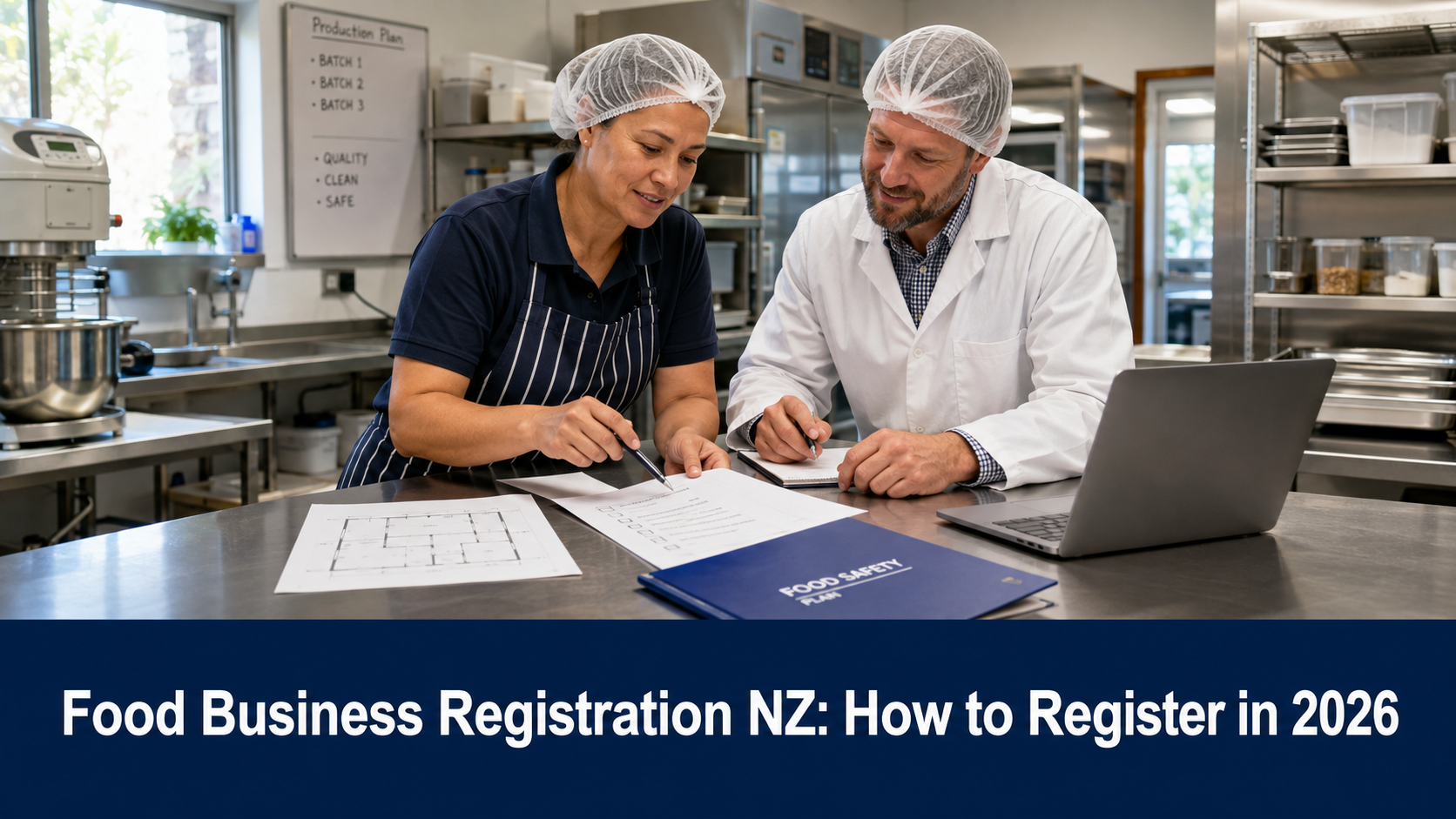
Need help registering a food business in New Zealand?
Access Food Verification & Auditing Limited (AFVA) provides practical food-business registration, Food Control Plan, National Programme, Custom FCP, verification and MPI compliance support across New Zealand.
Contact Access Food (AFVA) for Registration Guidance
Tell us what food you will make or sell, how it will be processed, where the business is based and how you will trade. We can help identify the likely registration pathway and the next documents you need.
Most New Zealand businesses that manufacture, prepare, serve, sell, store or transport food need to operate under the correct food-safety measure and be registered before trading. Registration is not one universal “food licence”. The correct application depends on the food activities, risk level, number and location of sites, legislation and intended market.
For many businesses under the Food Act 2014, the first decision is whether to operate under a Food Control Plan (FCP) or a National Programme (NP1, NP2 or NP3). The second decision is whether the registration should be submitted to the local council or the Ministry for Primary Industries (MPI). A business may also fall under the Animal Products Act, Wine Act or another pathway instead.
This guide explains the food business registration NZ process step by step, including common documents, fees, verification and mistakes that can delay approval. If you are searching specifically for licence terminology, also read our Food Licence NZ requirements and costs guide.
Quick answer: how do you register a food business in NZ?
Use MPI’s My Food Rules tool to identify the correct legislation and plan or programme. Prepare the required food-safety documents and scope of operations, arrange a verifier and obtain a confirmation letter where required, apply to the correct local council or MPI, pay the applicable registration fee and levy, then arrange the first verification after registration.
In this food registration NZ guide
- Who needs food-business registration?
- Which plan or programme applies?
- Register with your council or MPI?
- Step-by-step registration process
- Documents required
- Registration and verification costs
- What happens after registration?
- Home, online, mobile and multi-site businesses
- Renewals, ownership and changes
- Common registration mistakes
- How AFVA can help
- Frequently asked questions
Who Needs Food Business Registration in New Zealand?
Most commercial food activities require registration or another form of approval. Selling includes more than taking payment at a shop counter. Online sales, subscriptions, wholesale supply, bartering, food supplied as part of another paid service and promotional food may all be relevant.
| Business activity | Likely registration position | Important check |
|---|---|---|
| Café, restaurant, takeaway or caterer | Usually a template Food Control Plan | Processes, vulnerable consumers and wholesale activities |
| Food manufacturer | National Programme or Custom FCP depending on product and process | Risk, preservation method, shelf life and target consumer |
| Retail shop handling or preparing food | National Programme or template FCP | Whether food is only packaged, handled, reheated or manufactured |
| Home-based or online seller | Often must register, although specific exemptions may apply | Exact product, process, sales frequency and customer route |
| Food truck, market stall or mobile trader | Usually register with the council where the business is based | Base address, preparation location and event or trading approvals |
| Transport, storage or distribution | May be a National Programme or another legislative pathway | Product temperature, animal products and export activity |
| Importer or exporter | Food-business registration may be required alongside importer or exporter registration | Separate importer, exporter, RMP or market-access obligations |
Are there exemptions?
Yes, but exemptions are activity-specific and should not be assumed. Examples can include limited fundraising, one-off event sales and some very low-risk activities. MPI’s current My Food Rules tool also notes specific guidance for qualifying home-based bakers making shelf-stable cakes and selling directly to consumers. Even when registration is not required, the food must still be safe and suitable, and council rules may still apply.
Use the official My Food Rules tool and review MPI’s Food Act exemption guidance before relying on an exemption.
Which Food-Safety Plan or Programme Applies?
Under the Food Act, Food Control Plans are generally used for higher-risk or more complex food activities, while National Programmes apply to lower and medium-risk activities. The plan is determined by what the business actually does—not by what the owner would prefer to register.
| Pathway | Typical examples | Key feature |
|---|---|---|
| Template Food Control Plan | Restaurants, cafés, takeaways, caterers and many food retailers | Uses an MPI-approved template for covered activities |
| Custom Food Control Plan | Businesses with unique, diverse or higher-risk manufacturing activities | Tailored plan; evaluation may be required before MPI registration |
| National Programme 1 | Some food transporters, distributors, horticultural producers and packhouses | Lower-risk Food Act activities |
| National Programme 2 | Bread, biscuits, confectionery, preserves and some chilled-food retail | Lower to medium-risk processing and retail activities |
| National Programme 3 | Beverage, flour, dry-mix and food-additive manufacturing; retailers handling food | Medium-risk Food Act activities |
| Other legislation | Animal-product primary processing, wine businesses and certain pet-food activities | May require an RMP, WSMP or another approval instead of Food Act registration |
For a detailed comparison, read Food Control Plan vs National Programme. If your activity involves primary processing of animal material or animal products, see our RMP compliance support information before assuming the Food Act pathway applies.
Do You Register With Your Local Council or MPI?
The registration authority depends on the plan or programme and where the business operates. “MPI registration” is not automatically better or more national. Mobile and online businesses generally register with the council where the business is based, even if sales occur elsewhere.
| Registration situation | Registration authority | Important note |
|---|---|---|
| Template FCP, primarily food service or retail, one council area | Local council | Includes many cafés, restaurants and takeaways |
| National Programme, one council area | Local council | Arrange a suitable verifier before applying |
| Mobile or online business | Council where the business is based | The base is normally where the mobile unit is kept or online business operates |
| Fixed sites in more than one council area | Each council separately or MPI as a multi-site registration | Compare administration, scope and verification arrangements |
| Custom Food Control Plan | MPI | Evaluation may be required; verifier confirmation is required |
| My Food Plan | MPI | Follow the specific My Food Plan application process |
Check MPI’s current Register a food business guidance before submitting an application. Registration decisions can depend on details not visible in a short business description.
How to Register a Food Business in NZ: Step by Step
| Step | What to do | Practical tip |
|---|---|---|
| 1. Describe the business | List every product, process, site, sales channel and intended consumer | Include wholesale, online and occasional activities—not only the main product |
| 2. Use My Food Rules | Identify the legislation and Food Control Plan or National Programme | Save the result and recheck it if the proposed operation changes |
| 3. Prepare the system | Obtain or develop the correct plan, programme, procedures and records | Make documents match the real premises and process |
| 4. Arrange evaluation if required | Have a custom FCP evaluated unless an applicable exemption or pre-evaluated route applies | Book the evaluator early and confirm the required technical evidence |
| 5. Confirm the verifier | Select a recognised verifier and obtain a confirmation letter where required | Confirm scope, price, travel and first-verification availability |
| 6. Complete the application | Submit the correct form, scope of operations and supporting documents | Ensure names, addresses and activities agree across every document |
| 7. Pay fees and levy | Pay the registration authority’s charges and applicable Food Business Levy | Budget separately for verification and travel |
| 8. Begin operating and get verified | Implement the system, train staff, keep records and complete verification | Do not wait until the verification visit to start using the records |
What Documents Are Needed for Food Registration?
Requirements vary between councils and pathways, but the following items are common. Always use the current form issued by the registration authority.
| Document or information | Purpose | Common problem |
|---|---|---|
| Registration application | Identifies the operator, sites, plan and contact people | Wrong form or inconsistent legal name |
| Scope of operations | Records sectors, products, processes and trading activities | Activities omitted or boxes selected without understanding them |
| Plan or programme details | Shows which risk-based measure the business will follow | Outdated template or plan that does not cover all activities |
| Verifier confirmation | Confirms a suitable provider will complete required verification | Verifier lacks the correct scope or cannot meet the deadline |
| Evaluation report | Supports registration of a Custom FCP where evaluation is required | Open findings or changes after evaluation |
| Company and site details | Confirms legal entities and each operating address | Trading name used instead of the correct operator name |
| Council-specific information | Addresses local planning, building, trade-waste or application requirements | Assuming food registration replaces other council approvals |
How Much Does Food Business Registration Cost in NZ?
There is no single nationwide total. Councils set their own registration and verification charges. MPI has separate registration charges for applications made directly to MPI. Your full first-year budget can include several different cost categories.
| Cost category | How it is charged | 2026 planning note |
|---|---|---|
| Registration application | Set by the council or MPI according to the pathway | Check the current fee with the actual registration authority |
| Food Business Levy | Annual levy under the Food Act | For 2026–27: NZ$86.25 plus GST, or NZ$99.19 including GST |
| Council levy collection fee | May be added where a council collects the levy | MPI states councils may add up to NZ$12.65 including GST |
| Verification | Hourly, fixed or minimum fee plus possible travel | MPI guidance gives an indicative NZ$115–$210 hourly range plus travel |
| Custom FCP evaluation | Evaluator’s professional fee | Varies with complexity, validation and document readiness |
| Consulting, testing and premises work | Separate commercial or technical costs | Not normally included in the registration fee |
The current official charges and levy are published on MPI’s Food Act fees and charges page. Fees change, so confirm them immediately before applying rather than relying on an older article or quotation.
What Happens After Your Food Business Is Registered?
Registration allows the business to operate under the specified plan or programme, but it does not prove ongoing compliance. Verification is the independent check that the business is actually following food-safety practices and producing safe and suitable food.
| After-registration task | What the business should do | Why it matters |
|---|---|---|
| Implement the plan or programme | Train staff and follow the applicable controls from the first day | A completed form alone does not demonstrate safe operation |
| Keep required records | Record monitoring, suppliers, traceability, corrective actions and other required evidence | The verifier needs evidence that controls are consistently followed |
| Complete first verification | Arrange the verifier visit within the applicable timeframe | MPI states a new Food Act business normally needs verification within six weeks of registration |
| Close any findings | Correct problems, investigate causes and provide suitable evidence by the deadline | Unresolved non-compliances can affect the outcome and future frequency |
| Maintain and renew registration | Monitor expiry, pay fees and notify changes | Expired or inaccurate registration can prevent lawful operation |
Read MPI’s food-business verification guidance and AFVA’s Food Business Verification Process page. Verification frequency after the initial visit depends on the risk-based measure, operation and performance.
Home, Online, Mobile and Multi-Site Food Registration
Home-based food businesses
A home kitchen is not automatically exempt. The plan or programme depends on the products and processes, while the council may also review planning, building, wastewater, nuisance or other local requirements. Check whether the home is suitable before purchasing equipment or printing packaging.
Online food businesses
Selling through a website, app or social-media page can still be a food business. Online businesses normally register with the council where the business is based. The business must also manage labels, storage, delivery temperatures, traceability and recall responsibilities.
Food trucks and market stalls
A mobile operation generally registers with its home council and can trade in other districts under that registration, subject to local event, location and trading permissions. Include any separate preparation or storage premises in the registration review.
Businesses with several sites
Fixed sites in more than one council district can sometimes be registered separately with each council or together through MPI. The best option depends on legal entities, consistency of activities, verification arrangements, administration and cost. Do not assume all sites can be added to one registration without assessment.
Renewals, Change of Ownership and Business Changes
Food registration must remain current and accurate. Food Control Plans are generally renewed annually, while National Programme registrations are generally renewed every two years. Confirm the exact expiry date shown on the registration certificate.
- New owner: Food-business registration is not simply transferred like a piece of equipment. The new operator should contact the registration authority and arrange the correct registration before taking over.
- New product or process: Review My Food Rules and the scope of operations before launch. The change may move the business to a different programme or require a plan amendment.
- New premises: Notify the authority and verifier. Registration, verification and local approvals may need updating.
- New verifier: Advise the registration authority and keep confirmation of the new arrangement.
- Business closure: Formally surrender or cancel the registration rather than allowing correspondence and fees to continue.
Common Food Registration Mistakes
- Choosing a plan from the business name: “Bakery”, “manufacturer” or “retailer” is not enough; the exact products and processes determine the pathway.
- Submitting to the wrong authority: Council and MPI registration responsibilities differ by plan, location and number of sites.
- Leaving out activities: Wholesale supply, online sales, delivery, offsite storage and occasional catering may affect the scope.
- Using the wrong legal name: The operator, trading name and company details must be clear and consistent.
- Waiting too long to find a verifier: National Programme and Custom FCP applications require verifier arrangements, and availability may affect opening dates.
- Confusing registration with verification: They are separate steps and commonly involve separate fees.
- Ignoring other approvals: Food registration does not replace planning, building, trade-waste, alcohol, fire-safety or workplace requirements.
- Starting without implementation: Staff should follow the plan and keep records from the beginning, not only before the verifier arrives.
How AFVA Can Help With Food Business Registration
Access Food Verification & Auditing Limited supports start-ups, home businesses, manufacturers, retailers, food-service operators, importers, distributors and multi-site businesses across New Zealand. Depending on the operation and independence requirements, support may include:
- Initial review of products, processes, sites and trading model
- Food Control Plan versus National Programme guidance
- Scope of operations review
- Template FCP, National Programme and Custom FCP support
- Custom Food Control Plan evaluation within applicable recognised scope and independence arrangements
- Food-safety procedures, records and implementation support
- Food Control Plan verification and National Programme verification within recognised scope
- Pre-verification gap assessment and corrective-action support
- Food labelling, shelf-life and wider MPI compliance support
A consultant can help prepare the business, but the registration authority makes the registration decision. Using a consultant does not guarantee registration or a particular verification result.
Ready to register your food business?
Send AFVA your products, process, location, sales method and planned opening date. We can help you identify the next step and request the information needed for a quotation.
Frequently Asked Questions
1. How do I register a food business in New Zealand?
Use My Food Rules to identify the correct plan or programme, prepare the required documents, arrange a verifier and confirmation letter where required, then apply to the correct council or MPI and pay the applicable charges.
2. Do I register my food business with MPI or the council?
Most single-district, mobile and online Food Act businesses register with their local council. Multi-site businesses operating across council districts may have an MPI option, while Custom Food Control Plans are registered with MPI.
3. Is food registration the same as a food licence?
People often use “food licence” informally, but the legal process normally involves registering a Food Control Plan, National Programme or another applicable programme and then completing verification.
4. Do home-based food businesses need registration?
Many do. The answer depends on the food, process, sales route and any applicable exemption. A domestic kitchen does not automatically remove Food Act responsibilities.
5. Do online food sellers need registration?
Often yes. An online business normally registers with the council where it is based and must meet applicable food-safety, labelling, storage, delivery and traceability requirements.
6. Do I need a verifier before I register?
National Programme and Custom Food Control Plan businesses need to arrange a suitable verifier before applying and include confirmation with the registration application. Check the exact requirements for your pathway.
7. When is the first food verification required?
MPI states that a new Food Act business normally needs its first verification within six weeks after registration. Existing businesses and special circumstances can have different timeframes.
8. How much is the Food Business Levy in 2026?
For the 2026–27 year beginning 1 July 2026, the levy is NZ$86.25 plus GST, or NZ$99.19 including GST. A council collection charge may also apply.
9. How often must food registration be renewed?
Food Control Plan registrations are generally renewed annually, while National Programme registrations are generally renewed every two years. Always confirm the expiry date on the certificate.
10. Can AFVA help me complete the registration process?
Yes. AFVA can review the proposed operation, help identify the likely pathway, review the scope and documents, support implementation and provide applicable evaluation or verification services subject to recognition and independence requirements.
Final Registration Checklist
- Every product, process, site and sales channel has been identified.
- My Food Rules has been completed using accurate information.
- The correct Food Control Plan, National Programme or other pathway is confirmed.
- The correct council or MPI registration route is confirmed.
- The scope of operations matches the real business.
- A verifier and confirmation letter are arranged where required.
- Evaluation is completed where required.
- Registration, levy, verification, travel and technical costs are budgeted separately.
- Staff, procedures and records will be ready from the first day of operation.
- The first verification and renewal dates are recorded.
Getting food business registration right at the start helps prevent application delays, incorrect fees, missing verification arrangements and expensive changes after opening. The strongest application is accurate, complete and supported by a food-safety system that genuinely reflects the operation.
General information only: Food registration requirements and charges can change and depend on the exact activity. Confirm the current pathway with MPI, your local council, registration authority and appropriately recognised providers before trading.
Need Practical Food Safety Support for Your Business?
Contact us for free initial guidance. We provide practical, plain-English food safety support for New Zealand food businesses across all service areas.
This article provides general information only and is not a substitute for professional advice specific to your situation. Contact us for guidance based on your actual food activities and requirements.