
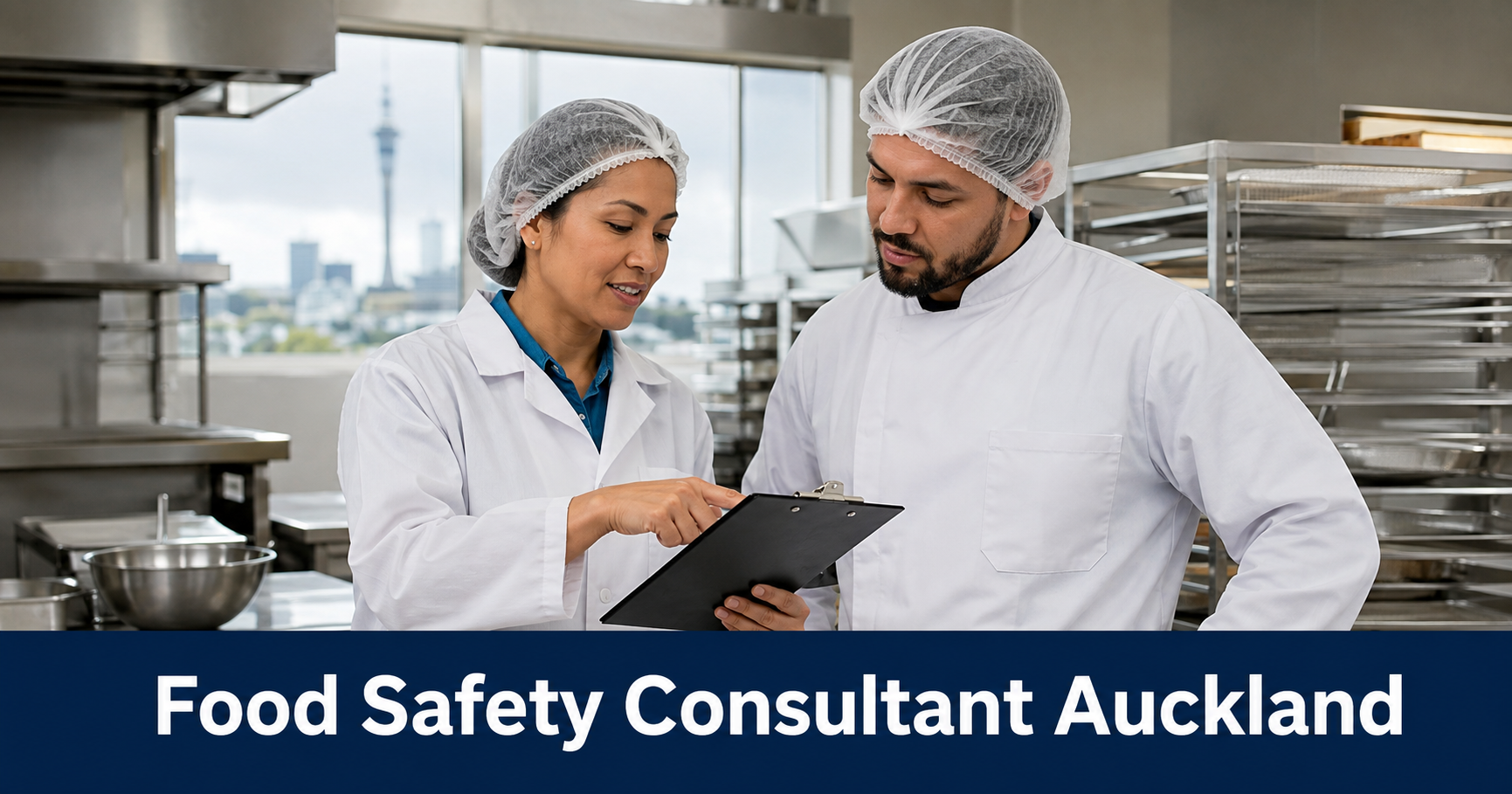
Need practical food safety help for your Auckland business?
Contact AFVA for food safety consulting support in Auckland. We provide free initial guidance to help you understand the service your business may need, including Food Control Plan and National Programme support, HACCP, audit preparation, corrective actions, food labelling, shelf-life planning and wider food-safety compliance.
Running a food business in Auckland involves more than preparing good food or manufacturing a reliable product. The business must understand the food-safety rules that apply, register under the correct pathway, implement suitable controls, keep evidence and be ready for verification, customer audits or certification assessments.
An experienced food safety consultant in Auckland can help turn those requirements into practical procedures, records and actions that suit the real operation. This can be valuable for a new café, restaurant, bakery or home-based business, as well as for a manufacturer, importer, distributor, childcare service, food brand or established business dealing with an audit problem.
Quick answer: what does a food safety consultant do?
A food safety consultant helps a business understand and implement applicable food-safety, quality and customer requirements. Support may include registration-pathway guidance, food-safety plans, HACCP, procedures and records, audit preparation, corrective actions, training, labels, traceability, recall readiness and certification support. A consultant does not replace MPI, Auckland Council, a recognised verifier or evaluator, and cannot guarantee registration, certification or an audit result.
In this Auckland food safety guide
- When to use a food safety consultant
- Consultant, verifier and evaluator roles
- Auckland food-business compliance pathway
- Food safety consulting services
- Auckland businesses that may need support
- Audit preparation and corrective actions
- How to choose a consultant
- How AFVA can support your business
- Frequently asked questions
When Should You Hire a Food Safety Consultant in Auckland?
The best time to seek advice is usually before an expensive or time-sensitive decision. Early input can help prevent a business from registering under the wrong measure, designing an unsuitable process, printing a non-compliant label, overlooking validation work or arriving at an audit without the required evidence.
Professional support may be useful when your business is:
- starting a new food business or moving to new premises;
- adding products, processes, equipment, customers or sales channels;
- uncertain whether it needs a Food Control Plan, National Programme, Risk Management Programme or another measure;
- developing or changing a HACCP plan or food-safety system;
- preparing for initial verification, a routine audit or certification;
- responding to non-conformances, an unacceptable verification result or a customer complaint;
- manufacturing or importing a product that needs a New Zealand label review;
- setting or extending shelf life;
- improving traceability, mock recall, allergen or supplier controls;
- investigating a microbiological result, foreign matter, quality problem or potential recall; or
- preparing for HACCP, ISO 22000, FSSC 22000, BRCGS, SQF or customer requirements.
| Business situation | Risk if not addressed | Potential consulting support |
|---|---|---|
| Starting or relocating | Wrong registration pathway, unsuitable layout, missing procedures or delayed opening. | Activity review, registration guidance, food-safety system and pre-opening readiness check. |
| Launching a product | Hazards, label errors, unsupported shelf life or inadequate supplier evidence. | HACCP review, specifications, labels, shelf-life study plan and traceability controls. |
| Audit approaching | Missing records, staff uncertainty, repeat findings or certification delay. | Gap assessment, record review, internal audit, staff preparation and action plan. |
| Non-conformances received | Weak root-cause response, rejected evidence, overdue close-out or recurrence. | Finding review, root-cause analysis, corrective action and evidence organisation. |
| Complaint or product issue | Unsafe product, incomplete investigation, poor traceability or delayed escalation. | Risk review, investigation plan, traceability check, corrective action and recall readiness. |
Food Safety Consultant, Verifier, Evaluator or Registration Authority?
These roles are related but not interchangeable. MPI explains that a food consultant can help a business create food-safety plans and follow food-safety standards. A recognised verifier independently checks whether the business is complying in practice, while an evaluator assesses a custom Food Control Plan before registration. The relevant council or MPI acts as the registration authority.
| Role | Main purpose | What the business should understand |
|---|---|---|
| Food safety consultant | Advises, develops, reviews, trains and helps implement practical systems and improvements. | Does not approve the business or guarantee an audit result. |
| Recognised verifier | Independently checks whether the registered plan or programme is effective and followed. | Must work within recognised scope and applicable independence requirements. |
| Recognised evaluator | Assesses whether a custom Food Control Plan is likely to meet legal requirements before registration. | Evaluation is not the same as operational verification. |
| Registration authority | Processes the application and registers the business under the applicable Food Act measure. | This may be Auckland Council or MPI, depending on the business structure and activities. |
Consulting and verification must be scoped carefully
A business should not assume that the same person who develops or substantially changes its food-safety system can later provide every independent assessment. Recognition, impartiality and conflict-of-interest requirements may affect who can evaluate or verify the business. AFVA confirms the permitted scope and service arrangement before work starts.
The Food-Safety Compliance Pathway for an Auckland Business
Most businesses selling food must follow the Food Act 2014, but the correct pathway depends on the foods sold and the activities performed. MPI’s My Food Rules tool is the official starting point. It can help identify whether the business may operate under a template or custom Food Control Plan, National Programme, another regime or an exemption.
- Define all activities. List products, processes, customers, locations, wholesale or retail activities, importing, storage, transport and any animal-product operations.
- Identify the applicable measure. Use My Food Rules and confirm uncertainties with the appropriate registration authority or a suitably experienced consultant.
- Prepare the system. Obtain or develop the required plan or programme, then customise procedures, records, responsibilities and training for the actual operation.
- Confirm the verifier. Some registration applications require confirmation of verification arrangements. Check who is authorised to verify the relevant scope.
- Register the business. The authority may be Auckland Council or MPI, depending on the business’s activities and geographic structure. MPI’s food-business registration guidance explains the decision.
- Implement before verification. Staff should follow the system and generate genuine operating records—not blank forms completed just before the visit.
- Complete verification within the required timeframe. The deadline depends on the plan or programme and whether the business is new or existing. Confirm the date stated by the registration authority.
- Close findings and maintain the system. Address corrective actions by their due dates, review changes and keep registration current.
AFVA can provide guidance through the food-business registration process, explain the verification process, and provide recognised Food Control Plan verification, National Programme verification or custom Food Control Plan evaluation where the requested work is within recognised scope and independence requirements are satisfied.
Food Safety Consulting Services for Auckland Businesses
Food safety consulting should be matched to a defined problem and useful output. A generic folder of templates is rarely enough. Procedures must reflect the site, products, equipment, hazards, staff responsibilities and evidence expected by the relevant authority, verifier, customer or certification body.
| Service area | Examples of support | Typical output |
|---|---|---|
| Food-safety systems | FCP, National Programme, HACCP, RMP or customer-system review and improvement. | Practical procedures, records, responsibilities and implementation plan. |
| Audit readiness | Gap assessment, internal audit, evidence review, facility walk-through and staff preparation. | Prioritised action plan with gaps, owners and due dates. |
| Corrective actions | Finding interpretation, immediate correction, root cause, preventive action and evidence review. | Clear close-out response and organised supporting evidence. |
| Product compliance | Label review, product specifications, allergen assessment, shelf-life planning and supplier documents. | Documented gaps, technical plan and corrected information for approval. |
| Traceability and recall | Traceability review, mock recall, mass balance, contact lists and recall procedure. | Mock-recall report, reconciliation result and improvement actions. |
| Certification support | Readiness for HACCP, ISO, BRCGS, SQF or customer standards. | Standard-specific gap review, system improvements and audit plan. |
Relevant AFVA services include food safety and quality consulting, HACCP consulting, food safety audit preparation, internal and supplier audits, food labelling review, shelf-life testing support and product issue investigation.
Which Auckland Food Businesses Can Benefit?
Auckland’s food sector includes small owner-operated businesses and complex manufacturers, importers and distribution networks. The right controls differ significantly between a home bakery and a chilled ready-meal factory, so advice should be proportionate to the activity and risk.
| Business type | Common support needs |
|---|---|
| Cafés, restaurants and takeaways | Food Control Plan implementation, temperature control, cleaning, allergen management, staff training and verification preparation. |
| Bakeries, caterers and home businesses | Registration pathway, process controls, labels, shelf life, records and pre-verification readiness. |
| Food manufacturers and brands | HACCP, validation, supplier approval, specifications, traceability, environmental monitoring and certification. |
| Importers and distributors | Importer responsibilities, supplier evidence, label compliance, storage, traceability, complaints and recalls. |
| Childcare and institutional food services | National Programme or FCP controls, vulnerable-person risks, allergen communication, records and staff competency. |
| Warehouses and cold stores | Receiving, temperature monitoring, stock status, pest control, transport, traceability and customer audits. |
| Dietary supplement businesses | Classification screening, formula and dose review, labels, claims, supplier controls, quality systems and importing requirements. |
Audit Preparation, Verification Readiness and Corrective Actions
A consultant should not create artificial records or coach staff to give rehearsed answers. Effective preparation checks whether the business has implemented its system, whether records are credible and complete, and whether staff can explain the controls they actually perform.
A pre-audit review may examine:
- registration scope, approved activities and current plan or programme;
- previous reports, open findings and evidence of sustained correction;
- food-safety records, including temperatures, cooling, cleaning and corrective actions;
- staff training and practical competency;
- supplier approval, receiving and product specifications;
- allergen controls and label accuracy;
- traceability, mass balance, mock recall and complaint handling;
- calibration, preventive maintenance and pest management;
- HACCP monitoring, validation and verification records; and
- facility condition and actual food-handling practices.
If findings have already been raised, the response should address more than the visible symptom. A strong corrective action usually distinguishes the immediate correction, the root cause, the action preventing recurrence, the person responsible, the completion date and the evidence demonstrating implementation. AFVA’s audit preparation service can support businesses before an assessment, while wider consulting support can help with corrective-action planning and system improvement.
How to Choose a Food Safety Consultant in Auckland
Choose a consultant for relevant competence and a clear scope—not simply the lowest hourly rate. A poorly defined assignment can cost more if it produces generic documents, misses a regulatory boundary or fails to prepare the business for implementation.
| Selection question | What a useful answer should clarify |
|---|---|
| Do you understand my sector? | Relevant products, processes, hazards, standards and business type. |
| What exactly is included? | Documents, site work, meetings, training, revisions, follow-up, exclusions and deliverables. |
| Who remains responsible? | The operator owns the system, approves decisions, implements controls and maintains evidence. |
| Are there independence limits? | Whether consulting affects who may later evaluate, verify or certify the work. |
| How is pricing determined? | Fixed scope or hourly rate, assumptions, travel, external laboratory costs and change requests. |
| Will the system work in practice? | How staff will be involved, trained and checked after the documents are issued. |
Information to prepare before requesting a quote
- business name, Auckland location and contact details;
- products, processes, customers and sales channels;
- current registration, plan, programme or certification standard;
- the problem to solve and the deadline;
- previous audit, verification or council reports;
- current procedures, forms and representative completed records;
- product labels, specifications and process flow diagrams where relevant;
- number of sites and whether onsite work is required; and
- the outcome you expect, such as a gap report, revised plan, training or close-out support.
How AFVA Supports Auckland Food Businesses
Access Food Verification & Auditing Limited is based in Auckland and supports food businesses across New Zealand. Depending on the assignment, support may be provided onsite, remotely or through a combination of document review, meetings, site assessment and follow-up.
| Stage | What happens | Purpose |
|---|---|---|
| 1 | Initial discussion | Understand the business, issue, deadline and whether AFVA is the appropriate provider. |
| 2 | Scope confirmation | Define deliverables, responsibilities, exclusions, timeframe and cost basis. |
| 3 | Evidence review | Assess current documents, records, reports, products and regulatory or standard requirements. |
| 4 | Practical assessment | Where needed, examine the site, process and staff practices against the documented system. |
| 5 | Actions and deliverables | Provide the agreed report, documents, training, corrections or implementation plan. |
| 6 | Follow-up | Check progress, clarify evidence and help the business embed sustainable improvements. |
Common Mistakes When Seeking Food Safety Help
- waiting until immediately before registration, opening or an audit;
- asking for a generic manual without describing the actual products and processes;
- assuming a consultant can approve the business or guarantee a pass;
- providing only blank forms instead of representative completed records;
- focusing on paperwork while site practices remain uncontrolled;
- copying another business’s HACCP plan or Food Control Plan without validation;
- printing labels before ingredients, allergens, claims and legal information are reviewed;
- closing a finding with a photograph but not addressing its root cause;
- failing to involve the staff who must implement the system; and
- not clarifying consulting, verification and evaluation independence at the start.
Looking for a Food Safety Consultant in Auckland?
Tell AFVA what your business does, the issue you need to solve and your deadline. We will provide free initial guidance and confirm the most appropriate next step.
Contact AFVA for Free Initial Guidance Email info@foodverification.co.nzFrequently Asked Questions
1. What can a food safety consultant in Auckland help with?
Support can include registration-pathway guidance, Food Control Plans, National Programmes, HACCP, procedures and records, audit preparation, corrective actions, internal audits, training, labels, shelf life, traceability, recalls, product investigations and certification readiness. The exact scope should be based on the business’s activities and objective.
2. Do I legally have to hire a food safety consultant?
Usually, no. A business may prepare and manage its own system if it has the required competence and follows all applicable rules. MPI recognises that businesses may choose to hire a consultant to help create plans or follow food-safety standards. Evaluation or verification may still be legally required even when consulting is optional.
3. Can a consultant register my food business with Auckland Council?
A consultant can help identify the likely pathway and prepare information, but the operator applies to the appropriate registration authority and remains responsible for the accuracy of the application. Depending on the business structure and activities, the registration authority may be Auckland Council or MPI.
4. Is food safety consulting the same as verification?
No. Consulting helps the business develop, review or improve its system. Verification is an independent assessment by a recognised verifier to check whether the registered plan or programme is effective and followed in practice. Independence requirements may affect who can perform each role.
5. Can AFVA help me prepare for an Auckland Council verification?
AFVA can provide pre-verification consulting support, such as reviewing your plan, records, training and practices. Before accepting work, AFVA will confirm the scope and any independence or conflict-of-interest limitations that could affect a separate verification or evaluation service.
6. How much does a food safety consultant in Auckland cost?
Cost depends on the service, complexity, quality of existing documents, number of products or sites, onsite time, urgency and required deliverables. Ask for a written scope that explains the fee basis, assumptions, exclusions, travel and any external laboratory or specialist costs.
7. Can a consultant guarantee that my business will pass an audit?
No reputable consultant should guarantee an audit, verification or certification result. The outcome depends on the business’s system, implementation, evidence, site condition, staff practices and the independent assessor’s findings. Consulting can improve readiness but cannot replace the operator’s responsibility.
8. Does AFVA work only with Auckland businesses?
No. AFVA is based in Auckland and supports food businesses across New Zealand. Depending on the service, work may be completed onsite, remotely or through a combination of document review, online meetings and practical follow-up.
9. What should I send before the first consultation?
Send a short business description, products and processes, location, current registration or standard, the issue to solve, deadline and relevant reports or documents. For an audit problem, include the exact findings. For product work, include the formula, process, draft label, specifications and proposed shelf life where available.
10. When is the best time to contact AFVA?
Contact AFVA before finalising premises, registration, product processes, labels or audit dates. Early advice usually provides more options and reduces avoidable rework. Urgent corrective-action or product-issue support can also be discussed when a problem has already occurred.
Official New Zealand Sources
- MPI – Hiring a Food Consultant
- MPI – My Food Rules Tool
- MPI – Register a Food Business
- MPI – Getting Your Food Business Verified
- MPI – Food Control Plans
- MPI – National Programmes
- MPI – Food Safety Registers and Lists
Important: This article provides general information and was prepared using official sources available in August 2026. The correct requirements depend on the business’s products, processes, locations, customers, registration pathway and applicable standards. Confirm requirements with the relevant authority and obtain advice specific to your operation.
Need Practical Food Safety Support for Your Business?
Contact us for free initial guidance. We provide practical, plain-English food safety support for New Zealand food businesses across all service areas.
This article provides general information only and is not a substitute for professional advice specific to your situation. Contact us for guidance based on your actual food activities and requirements.