
Need help investigating a foreign-matter complaint? Review AFVA’s product issue investigation support or contact AFVA for free initial guidance.
A foreign matter complaint about food creates two connected tasks: responding to a possible product concern and preserving enough reliable evidence to investigate it. A loose object, a cropped photograph and a copied batch number may each be useful, but they do not tell the same story.
This guide is for New Zealand food manufacturers, brands, importers and quality teams receiving a reported object such as glass, metal, plastic or rubber. It explains how to keep the object, packaging and chronology connected and prepare a focused investigation. It does not identify an object, determine that food is safe or replace an incident response.
Quick answer: Assess immediate product concerns through your applicable procedures while preserving the original complaint, photographs, packaging, available object and batch information. Record handling and uncertainty, link the report to production and distribution evidence, and agree the question an investigation should answer. Do not clean or alter an object without suitable advice, infer a cause from appearance alone, or postpone necessary controls and notifications while waiting for a complete file.
Assess the concern while preserving the evidence
Start with the potential effect on people and product. A report of a hard or sharp object, damaged packaging, injury or several similar complaints needs prompt assessment through the business’s incident arrangements. Do not wait for an object to arrive before considering whether suspect product needs control or whether advice and notification are required.
MPI’s food recall guidance for businesses separates gathering information, holding potentially affected product, informing the appropriate people, assessing risk and deciding the response. It asks about the material, size and shape, number of reports, and any sieve, X-ray or other control that may have failed.
An initial complaint is evidence to assess, rather than proof of a cause or a complete affected-batch boundary. Record what is uncertain. Use the reporting route and requirements applying to your operation; an investigation brief does not replace necessary notification or a recall decision. If understanding the problem is delayed, MPI advises contacting the verifier or New Zealand Food Safety.
Keep the object, product and packaging connected
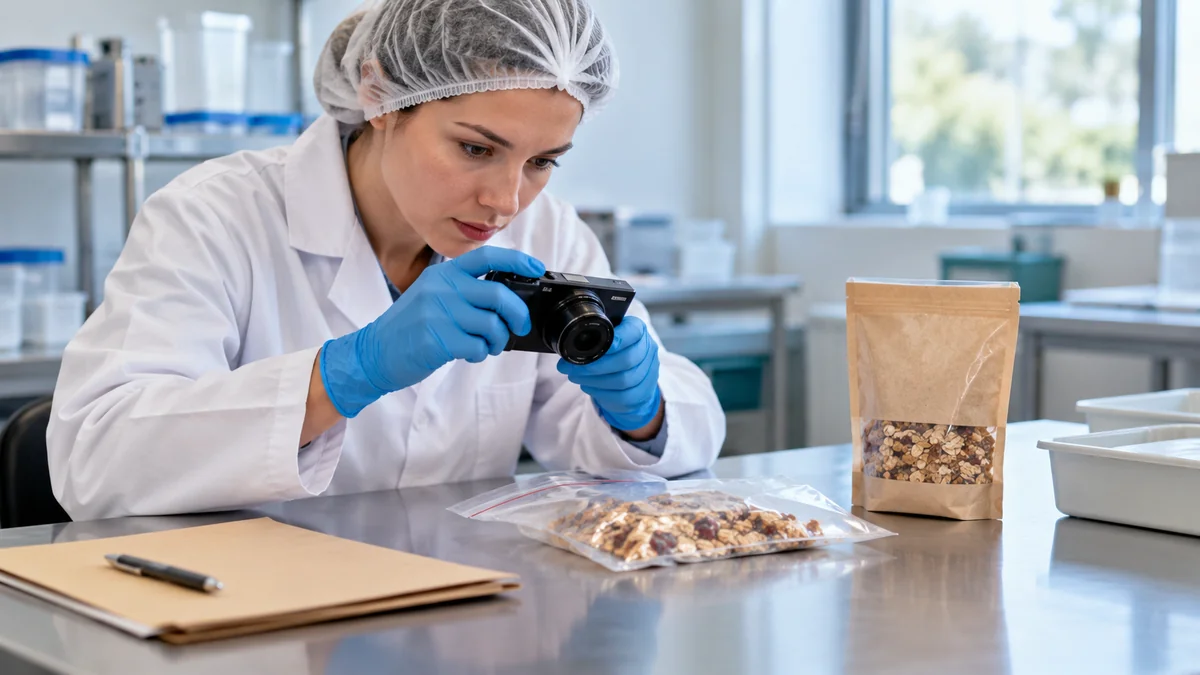
The object and its context can answer different questions. An object without its packet may be difficult to connect to a product or batch. A packet without the object may leave questions about the material unresolved. Original photographs can preserve how something appeared before it was moved, even when physical material is unavailable.
FSANZ’s food complaint guidance on keeping packaging and foreign objects recommends retaining the original container or packaging and the relevant object. Its Australian agency contacts are separate from the New Zealand business reporting arrangements discussed here.
As a practical evidence-preservation approach, we recommend agreeing how the business will receive, identify and secure the available material:
- Keep the original pack, batch or lot marking, date marking and remaining product where available. Record which items belong together.
- Keep original photographs and the original complaint message. A cropped image or a typed summary can be useful working material, but should not replace the original.
- Record when material was received, who handled it and what was changed. If it was already washed, opened, transferred or damaged, say so.
- Avoid cleaning, cutting, breaking or testing the object without an agreed method. Do not handle a sharp or unknown item directly.
- Ask the intended investigator or laboratory about containment, storage and transport before sending material. Follow appropriate product storage arrangements; this guide is not a sampling or shipping method.
Preservation must be safe and proportionate. Do not recreate the discovery by placing the object back into food or packaging. Keep observations made before and after receipt distinguishable. If the complainant no longer has an item, retain that fact instead of describing an incomplete sample as complete.
Describe what is observed before naming the material
Use a neutral description: colour, approximate dimensions, shape, flexibility, visible edges and how the object was reported to have been found. State who made each observation and whether it came from a photograph, the complainant’s account or examination of the actual item.
“Reported metal fragment” and “material identified as metal by an agreed examination” are different statements. A clear photograph does not necessarily identify composition, sharpness or origin. If measurements are available, record the method and uncertainty; do not treat a photograph with no reliable scale as an exact measurement.
MPI considers features such as hardness, sharpness, potential harm and multiple reports. Its guidance recognises that context matters, including glass, beverages and products intended for babies or children. Do not convert a size measurement into a universal safe-object rule or use a reassuring appearance to close an assessment.
Connect the complaint to batches and distribution
Build the product link from actual identifiers. Capture the brand, product name, pack size, batch or lot code and date marking as shown. Add purchase or delivery details and the reported sequence of opening, preparation and discovery. Identify estimated dates rather than making them look exact.
Use the business’s records to investigate that link: ingredient and packaging lots, production and packing records, line changes, rework where relevant, stock locations and distribution. MPI recommends considering potentially affected products or batches before and after the one first identified. Record why the proposed boundary is justified and what information could change it.
Keep a product hold distinct from the wider response. A hold controls suspect stock within the business’s control; traceability helps identify what exists and where it went. A recall decision also considers risk and distribution. MPI uses withdrawal for removal from trade where the issue is neither safety nor suitability, so do not apply that label automatically to a complaint described as “quality”.
For a series of complaints, the recurring product complaint investigation brief guide explains how to assemble the wider chronology. Preserve each individual object-to-product link before combining events into a pattern. Similar appearance or the same customer does not establish that two reports have the same cause.
Test possible sources against records and observations
Organise possible explanations as hypotheses with supporting and conflicting evidence. Depending on the product and process, questions may concern ingredients, packaging, equipment condition, maintenance, handling or another part of the supply chain. Do not select one explanation simply because an object resembles something at the site.
For example, a clear fragment reported in an opened pack could prompt questions about packaging, equipment components and subsequent handling. The report alone cannot decide between them. Relevant evidence might include the actual fragment, packaging specifications, breakage or maintenance records and the sequence of handling. This is a hypothetical illustration, not an AFVA case.
Where a detection or removal control is relevant, obtain the actual monitoring, challenge, rejection and fault records for the period under review. Ask what the control was designed to detect and what happened to rejected product. A statement that “the detector passed” should not substitute for examining the applicable control, product and records.
Material identification or specialist examination may help answer a defined question. Agree that question and the suitable external provider before commissioning work. A material match can contribute evidence, but should not be described as proof of the complete contamination route without considering the other findings.
Send a focused foreign-matter investigation brief
A useful first enquiry states the question, available evidence and immediate actions already taken. Send enough information to scope the work without distributing unnecessary personal details from the original complaint. Keep the full original records through the business’s appropriate arrangements.
- Product, location and responsible contact: identify the business, product, site or sites and person coordinating the response.
- Reported event: give the chronology, exact complaint wording, identifiers and original photographs, distinguishing confirmed facts from estimates.
- Material available: list the object, pack and product held, their condition, handling history and any missing items.
- Potential product scope: provide the current batch and distribution picture, hold arrangements and the reasons for uncertainty.
- Relevant records: identify ingredient, packaging, processing, maintenance and detection-control evidence, plus existing examination results.
- Actions and communications: record who was informed, advice received and decisions taken under the applicable incident procedures.
- Question and output: explain whether you need evidence review, an onsite assessment, specialist coordination, a summary of findings or corrective-action recommendations.
Agree responsibilities, exclusions and the basis for any further work. A report should separate observations, evidence-supported findings, unresolved hypotheses and recommended actions. A useful investigation can narrow possibilities while remaining unable to identify one definitive source.
Avoid changes that make the evidence harder to interpret
- Discarding the original pack after copying the batch code: retain it where available because other identifiers and condition may matter.
- Cleaning an object to make it easier to photograph: preserve its condition and obtain handling advice first.
- Calling a photograph a confirmed material identification: record the observation and its limits.
- Assuming a single affected packet or one normal control check defines the full scope: examine the relevant records and uncertainty.
- Closing the issue after replacing a machine part: record why that action addresses the evidence and how effectiveness will be checked.
- Waiting for a final investigation report before managing an immediate concern: controls, advice and required reporting can be needed earlier.
After the immediate issue is addressed, a separate mock recall and batch reconciliation exercise can help test future traceability arrangements. An exercise does not replace managing the real complaint or establish that its product can be released.
Frequently asked questions
Does every foreign-object complaint require a recall?
No automatic decision follows from the complaint alone. Assess the possible hazard, affected product and distribution using the applicable arrangements and MPI guidance. Do not assume that a single report is harmless or wait for repeated complaints before assessing a concern.
What if the customer has only a photograph?
Keep the original image and account, ask for product identifiers and clarify whether the object, packaging or remaining product still exists. Record what is unavailable. A photograph may help scope the enquiry while leaving material identity and origin unresolved.
Should we test the object ourselves?
Avoid an improvised test that could alter or destroy evidence. Agree the technical question and handling arrangements with a competent investigator or suitable external laboratory. Record any examination already performed and retain its results and limitations.
Can a passing metal-detector check close the complaint?
Do not treat one record as an answer to the whole event. Review the actual control, its intended capability, relevant product, period, rejection arrangements and other evidence. The investigation should explain what a record supports and what remains uncertain.
Can AFVA guarantee the source will be identified?
A guarantee should not be assumed. AFVA provides investigation and evidence-review support within an agreed scope. Findings depend on the available material, records and examination. The result can include several possible contributing factors or an unresolved cause.
Does an investigation summary authorise product release?
No. An evidence summary or consulting recommendation is separate from the business’s product disposition, reporting and any regulatory decisions. Confirm the requirements and responsible decision-makers applying to the particular event.
Discuss a defined investigation with AFVA
AFVA’s published product issue investigation service includes foreign-matter complaints, document and record review, onsite investigation where needed, sampling-plan support, laboratory coordination, likely-cause review and corrective-action recommendations. The exact work and any external specialist input need agreement.
Use AFVA’s product issue investigation service to discuss the available material and the question you need answered, or contact AFVA for free initial guidance. Explain any immediate concern and action already taken. Businesses remain responsible for required notifications; consulting support does not replace the verifier, New Zealand Food Safety or an appropriate external laboratory.
General information only: Requirements depend on the complete food activities, products, processes, locations and sales model. Use current official guidance and confirm the requirements applying to the specific business before relying on a classification, control, timeframe or record list.
Need Practical Food Safety Support for Your Business?
Contact us for free initial guidance. We provide practical, plain-English food safety support for New Zealand food businesses across all service areas.
This article provides general information only and is not a substitute for professional advice specific to your situation. Contact us for guidance based on your actual food activities and requirements.