
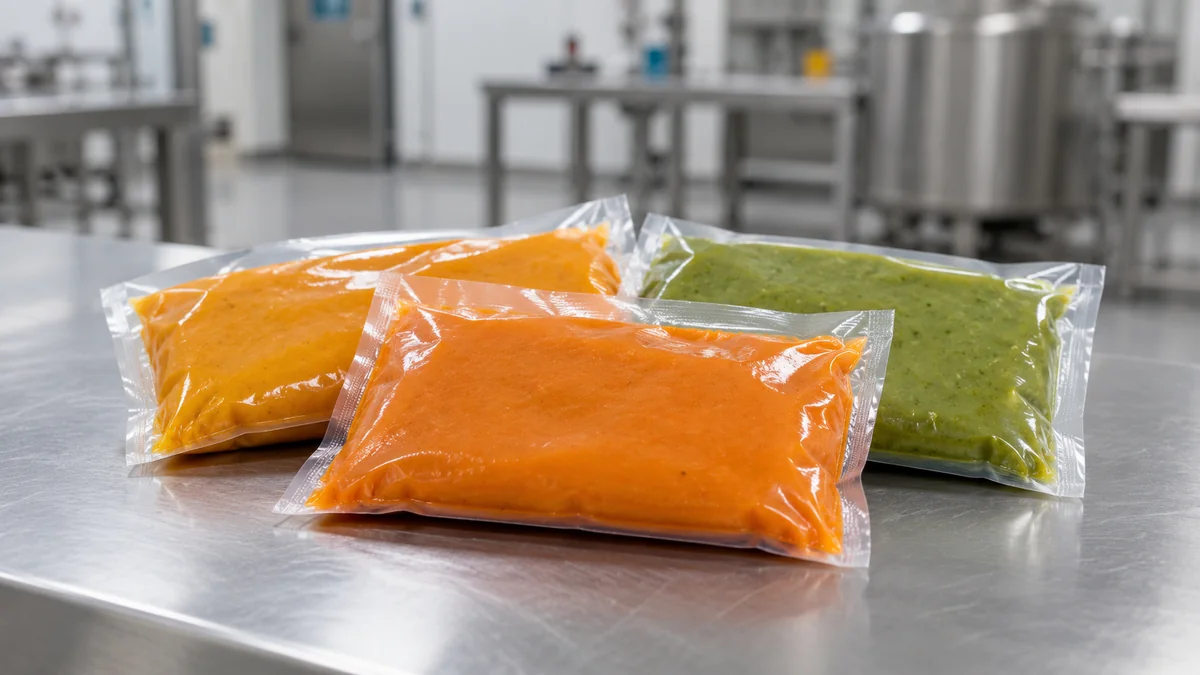
Considering high pressure processing for a food product? Explore AFVA’s new food product development support or contact AFVA for free initial guidance. Bring your product, packaging and proposed storage details so the technical questions can be scoped before a trial.
High pressure processing (HPP) may be worth investigating when a food business wants a different processing approach or a supported change to product life. The useful first decision is whether it fits the particular food and commercial operation—not which pressure setting another manufacturer uses.
This guide helps New Zealand manufacturers prepare a feasibility and trial brief. It does not prescribe a treatment cycle, approve a product or establish its shelf life. A promising sample is a reason to investigate further, rather than evidence that every batch will be safe.
Quick answer: Define the product, intended safety and quality outcomes, commercial process, pack and storage conditions. Confirm the regulatory route and agree the specialist evidence needed before commissioning a trial. Assess HPP performance in that actual system; do not assume that pressure alone makes a food sterile or suitable for room-temperature storage.
High pressure processing in NZ: start with the product, not a standard cycle
HPP subjects food to high pressure, commonly transmitted through water. Its effect on microorganisms depends on factors including the organism, formulation, acidity, water activity and temperature history. A published result in one food or a laboratory liquid does not automatically apply to a different commercial recipe.
The NSW Food Authority’s May 2022 HPP technical guidance explains important limitations. Pressure alone at or near ambient temperature has very limited or no effect on bacterial spores. Some bacterial cells can also be injured rather than permanently inactivated and may recover under favourable conditions during storage. This Australian document is useful technical background; it is not a statement of New Zealand legal requirements.
Treat safety, quality and storage as connected questions. A product may look acceptable immediately after treatment while a relevant safety concern remains. A desired extension to chilled life needs its own support, and neither HPP treatment nor an intact package establishes ambient stability.
Temperature also matters. Compression can warm the food, and heat exchange during holding can affect the temperature profile. Describing a process as non-thermal does not mean that temperature is unchanged or irrelevant. Record the conditions that the evidence actually covers.
Prepare a brief that a processor and technical adviser can assess
Begin with a controlled product description. Separate information already measured or established from assumptions and targets. Useful information includes:
- Recipe and variability: formulation version, ingredient specifications, relevant pH and water activity information, and differences between flavours or components.
- Process: preparation steps before HPP, any earlier heating or cooling, handling after treatment and the planned manufacturing site.
- Pack: material, closure, fill quantity, dimensions, headspace and any vacuum or modified atmosphere arrangement.
- Use and storage: intended consumers, ready-to-eat status, proposed storage and distribution conditions, unopened life and any opened-use instruction.
- Decision: the safety outcome to demonstrate, acceptable product quality and the business question the trial should answer.
For a product with distinct pieces, layers or fillings, describe those differences. Ask which component or variant may be most resistant to treatment or most capable of supporting growth. Do not select a convenient trial sample and silently extend the result to an entire range.
Keep the commercial target visible as well: acceptable texture, appearance, pack integrity and saleable output can all affect whether the technology is workable. These are criteria to agree before the trial, not benefits HPP is guaranteed to deliver. The broader food product development briefing guide can help organise the product information.
Confirm the regulatory route before treating HPP as an added production step
For Food Act operations, clause 4.3 and Schedule 1 of MPI’s Food Notice: Requirements for Food Control Plans and National Programmes matter. The Notice, issued on 24 April 2023 and effective from 30 June 2023, prohibits carrying out listed processes under a National Programme for the purpose of controlling microbiological hazards to ensure food safety. HPP is one of those listed processes. The accompanying guidance points to a registered Food Control Plan route.
MPI’s FA10MFP application for a new My Food Plan custom Food Control Plan also expressly excludes HPP among its listed technical processes and directs applicants to a standard custom FCP application and full evaluation. Do not assume that an existing National Programme or My Food Plan automatically covers the proposed HPP operation.
Confirm the position for the complete business with MPI and the relevant recognised professionals. This is not a claim that every use of pressure, or every meat, dairy, export or other operation, follows an identical Food Act route. Other applicable legislation, recognition and market requirements need their own assessment.
Review the pack and the full processing conditions together
Packaging needs to suit both the treatment and the product’s later storage and use. MPI’s food packaging rules and guidance says to select packaging for the food characteristics, processing temperatures, conditions of use and shelf life, and to obtain appropriate supplier assurance. A general food-contact statement alone does not answer whether a particular pack will perform during an HPP cycle.
Ask the packaging supplier and processor to identify the information needed for a compatibility trial. Agree how seal condition, leakage, distortion and any relevant barrier performance will be assessed after processing and through the intended product life. Confirm that the trial pack represents the commercial material, closure, fill and atmosphere.
Similarly, the recorded process should describe more than the maximum pressure. Ask the specialist to define the relevant initial temperature, pressure and temperature history, holding conditions and subsequent handling. Evidence from trial equipment must be assessed for its applicability to the commercial system.
If the trial uses a different recipe, pack or processing arrangement, document the difference and ask what further work is needed. A change should not disappear from the report merely because the samples look similar.
Agree what each part of the evidence will demonstrate
A useful trial plan separates different questions. The worksheet below is a recommended briefing tool, not a mandatory test protocol or a complete validation standard. The competent technical adviser should define the product-specific study and acceptance criteria.
On a small screen, swipe sideways to view all columns. Keyboard users can focus the table region to scroll.
A challenge study and an ordinary shelf-life study answer different questions. The former can investigate behaviour of selected organisms under defined conditions; the latter examines the product under specified storage conditions. A satisfactory routine sample result does not, by itself, demonstrate a required pathogen reduction.
Use an appropriate specialist and laboratory where microbiological work is needed. Deliberately inoculated challenge studies are specialist work, not an activity to improvise in the production facility. The NSW guidance specifically warns against introducing pathogenic cultures into a processing facility.
Agree how the final report will connect the results to the intended decision. It should identify what was studied, methods, raw results, deviations, interpretation, conditions covered and unresolved questions. Ask for a conclusion that can be used in the product file, rather than collecting certificates without an explanation of what they establish.
Make the handover to commercial processing explicit
If an external business will perform HPP, agree responsibilities before the first commercial lot. Useful questions include who controls the product specification, receives and stores it, records the treatment, handles a non-conforming cycle and authorises product release.
Keep a clear link between the manufacturer’s batch and the processor’s treatment records. Include relevant transport, storage and return-handling information. Agree who can access the evidence if there is a complaint, failed pack or suspected process departure. Outsourcing the pressure step does not remove the need for a controlled product decision.
Before relying on the trial conclusion, review whether the commercial recipe, pack, process and storage remain within its scope. A new flavour, changed fill, different site or proposed date extension should trigger a review of applicability rather than an automatic carry-over. The wider HACCP and food safety plan support service explains how control measures, records and validation evidence fit into the food safety system.
Common planning mistakes
- Ordering a treatment cycle before defining the food safety question.
- Assuming a successful study on another food proves this product.
- Treating pressure as sterilisation or permission for ambient storage.
- Testing an easier pack or recipe without documenting the commercial difference.
- Accepting a single immediate result as the whole shelf-life justification.
- Leaving the processor, laboratory and manufacturer unclear about responsibilities.
How AFVA can help scope the supporting work
AFVA’s published new product development service includes food safety risk review, process and packaging review, specifications and launch-readiness support. Its shelf-life study planning and review support includes laboratory coordination where required. Laboratory testing is carried out by appropriate accredited third-party laboratories.
Ask AFVA to scope that supporting review using your product and trial brief. Do not assume this means AFVA operates an HPP plant, designs pressure equipment, performs specialist challenge studies or acts as a thermal or pressure process authority. Specialist work, any regulated engagement and independence requirements must be agreed separately. Consulting does not approve the product or guarantee its safety or commercial success.
Frequently asked questions about HPP trial planning
Start with a defined trial decision
Bring the product, pack, proposed processing and storage conditions into one brief. Then agree the regulatory route, technical expertise and evidence needed to decide whether HPP is suitable for that operation.
Need help organising the product and evidence questions? Contact AFVA about product development and food safety support with your product details, planned trial and the decision you need to make.
General information only: requirements depend on the complete food activities, product, process, packaging, market and storage conditions. This article does not prescribe an HPP cycle, establish shelf life or replace product-specific specialist, laboratory or regulatory assessment.
Need Practical Food Safety Support for Your Business?
Contact us for free initial guidance. We provide practical, plain-English food safety support for New Zealand food businesses across all service areas.
This article provides general information only and is not a substitute for professional advice specific to your situation. Contact us for guidance based on your actual food activities and requirements.