
Need help with water-supply procedures and records? Review our food safety and quality consulting or contact AFVA for free initial guidance.
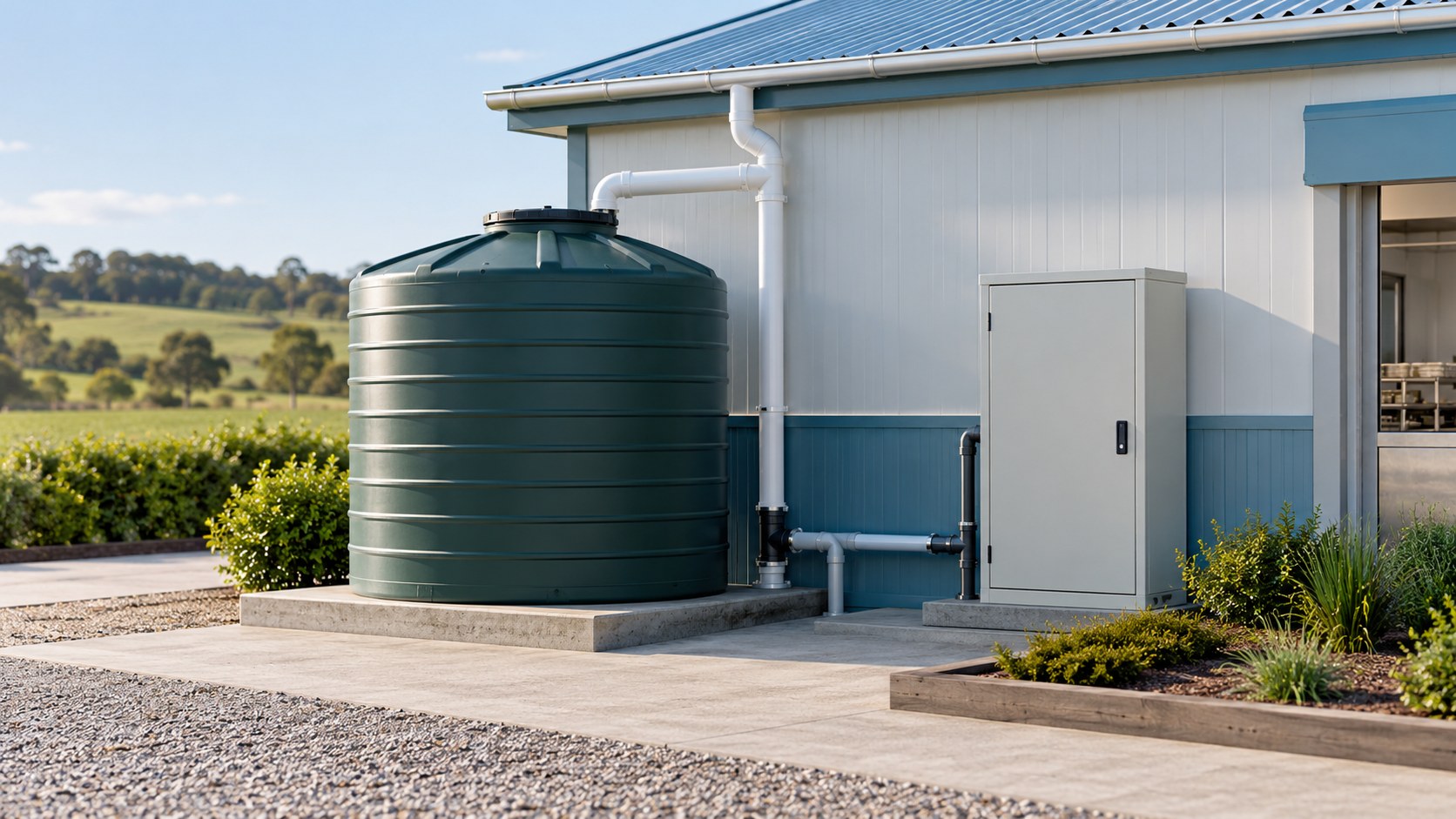
Non-mains water for a food business in NZ is more than a tank beside the building. The relevant system may include a roof, bore or other source, a delivery connection, storage, treatment, pipework and several points of use. A useful review follows the water all the way to the activity it supports.
This guide helps operators prepare a supply map and a workable evidence file. It does not declare a supply potable, design treatment, choose a test panel or set one testing frequency. Those decisions need the requirements and technical information applying to the actual operation.
Quick answer: Identify every water source and where it goes. Record who controls storage and treatment, what shows the system is working, and what staff will do if supply or treatment fails. Read that file alongside the applicable Food Control Plan or National Programme; a clear-looking tank and an old test report are not a complete operating system.
Start with the water requirements applying to your business
The FCP water provision in regulation 21 and National Programme water provision in regulation 55 require water to suit its use, avoid adversely affecting food safety or suitability, and have adequate supply capacity. They cover uses including food production, handling, personal hygiene and cleaning. Read the relevant provision with your actual plan or programme and associated requirements.
Do not copy a testing timetable from another business and treat it as a universal rule. Establish which current requirements apply, the supply and uses they cover, the evidence needed and who reviews it. If the arrangement also supplies drinking water, resolve the applicable drinking-water responsibilities separately rather than assuming food registration answers them.
The Water Services Authority–Taumata Arowai’s treatment and testing guidance explains that responsibilities depend on supply characteristics. Its general guidance identifies source, storage, treatment and distribution risks. It is useful context for the questions below, not a site-specific compliance determination.
Map the non-mains water supply from source to use
Draw a simple route that the operator, maintenance provider and reviewer can understand. Label different sources, tanks, treatment stages and outlets consistently. Include any backup connection or seasonal source and explain when it is used. Mark an uncertain connection for investigation; do not fill a gap in the drawing from memory.
Separate the original source from what happens onsite. Water delivered into a tank still passes through that storage and the site’s pipework. Conversely, a tank does not tell the reviewer whether its contents came from a roof, bore or delivery. Name the actual arrangement.
On a small screen, swipe sideways to view all columns. Keyboard users can focus the table region to scroll horizontally.
Taumata Arowai describes risks such as animal contamination of poorly protected tanks, contamination entering a bore, and treatment being affected by unsuitable source-water conditions. Use those examples to identify questions for a competent supplier or adviser. The appearance of a tank or the presence of a filter alone does not establish treatment performance.
Connect the supply map to evidence and responsibilities
Give each important control an owner. Who notices a warning, arranges servicing, checks the relevant record and decides whether an affected activity can continue? In shared premises, confirm who owns the equipment and who can obtain its records when the food business needs them.
Keep the equipment instructions, maintenance information and applicable test reports connected to the same named system. For a report, identify the sampling point, collection date and purpose. Ask whether it concerns source water, water after treatment or a particular outlet; those descriptions should not be treated as interchangeable.
Agree testing details with the appropriate laboratory and technical adviser under the requirements applying to the supply. Ask what to collect, where, how, when and how the result will be assessed. This article intentionally supplies no universal interval, acceptance number, disinfectant dose or treatment specification.
Review changes as well as routine records. A new source, tank, treatment unit, pipe route or production demand may make the old map incomplete. Keep a clear current version and the reason for changes. For broader premises questions, use the commercial-kitchen setup guide; it covers the wider fit-out rather than this operational water handover.
Plan for a water-supply or treatment disruption
Prepare the response while the supply is working. Possible triggers for review include loss of water, an equipment alarm, loss of power, a damaged tank, a changed source or an adverse result. A trigger is a reason to act under the applicable procedure; it is not, on its own, a diagnosis of the hazard.
- Identify the affected route: establish which tank, treatment stage, outlets and activities may be involved.
- Control the affected work: follow the applicable incident procedure and obtain advice where needed; do not carry on using suspect water merely to finish production.
- Confirm a workable alternative: check its suitability, volume and uses, rather than assuming drinking-water bottles resolve food preparation, handwashing and cleaning needs.
- Retain the history: record the observation, relevant times, actions, contacts and information used to decide the next step.
- Define restart evidence: agree what correction, assessment and confirmation are needed before the affected activities resume.
Do not apply one improvised treatment response to every event. A competent adviser needs to understand the suspected problem and the system. Also consider whether food already produced or equipment already washed needs assessment under the business’s procedures. This supply map does not decide product release or incident-notification duties.
A practical review checklist
- Every source, tank, treatment stage and relevant outlet is identified.
- The map matches the current operation, including backup arrangements.
- Applicable requirements and the people responsible for checking them are recorded.
- Instructions, service information and relevant reports can be retrieved.
- Staff know how to report a warning and find the disruption procedure.
- An unresolved gap has an owner and a next step, rather than an assumed PASS.
Frequently asked questions
Does clear water prove it is safe for food use?
No. Taumata Arowai explains that contamination may not be visible, smelled or tasted. Use the applicable assessment, controls and evidence rather than appearance alone.
Is one testing frequency correct for every food business?
This guide does not set a universal frequency. Establish the current requirements for the supply and food operation, including any additional drinking-water responsibilities.
Does fitting a filter settle the question?
No. Confirm the actual treatment purpose, operating requirements, capacity, maintenance and evidence with an appropriate technical provider. A component name is not a performance assessment.
Can I use an old report after changing the source?
Identify what the report actually covers and obtain advice on the changed arrangement. Do not assume a result for a previous source, date or outlet establishes the new system’s suitability.
Does this article certify my supply or replace a water specialist?
No. It helps organise the questions and records. Supply assessment, treatment design, analysis and any regulatory decisions need the appropriate competent providers and authorities.
How AFVA can help organise the food-safety controls
AFVA’s current food safety and quality consulting service supports procedures, records, controls and corrective actions. Bring the supply map, applicable food-safety measure, current instructions, relevant reports and unresolved questions to an initial discussion. Agree the specific consulting scope and independent arrangements; this article does not claim AFVA installs treatment, operates a laboratory or certifies water as potable.
Sources and scope
Sources were read on 1 November 2026. The practical worksheets in this article are AFVA recommendations, not regulator-issued forms.
- Food Regulations 2015: food-control-plan water requirements — Regulation 21: suitability for use, food safety and adequate supply capacity for FCP operations.
- Food Regulations 2015: national-programme water requirements — Regulation 55: corresponding water obligations for National Programme operations.
- Water Services Authority–Taumata Arowai: treatment and testing — General source/tank/treatment risks and supply-dependent drinking-water responsibilities; not a declaration that one system fits every business.
- AFVA food safety and quality consulting — Verified support for procedures, records, controls and corrective actions; not a water treatment installation or potability certification claim.
Need practical support? Contact AFVA to discuss the appropriate next step for your food business.
General information only. Requirements depend on the water source, supply arrangement, food activities and applicable regulatory framework. This recommended planning file is not a water-safety approval, treatment design, sampling protocol or authorisation to restart production.
Need Practical Food Safety Support for Your Business?
Contact us for free initial guidance. We provide practical, plain-English food safety support for New Zealand food businesses across all service areas.
This article provides general information only and is not a substitute for professional advice specific to your situation. Contact us for guidance based on your actual food activities and requirements.