
Preparing nutrition evidence for a product label? Review AFVA’s food labelling review service or contact AFVA for free initial guidance about the information to assemble.
Nutrition testing in NZ becomes more useful when the laboratory knows exactly which finished food, nutrient information and reporting basis you need. A quotation described only as “a nutrition panel” can leave important decisions unresolved until the results arrive.
This guide is for a food business that has already identified a reason to consider finished-product analysis. It follows the work from a clear brief to a traceable results handover. It does not prescribe a test package, sample count or operating method for every food.
For the earlier decision about which tests are relevant, start with our guide to food testing in New Zealand. If your issue concerns an existing calculator collection after a data update, use our separate saved Nutrition Panel Calculator recipe review guide.
Quick answer: Define the product and question first. Agree the nutrients, sampling approach, food form, analytical methods and reporting units with a suitable external laboratory. Then reconcile the report with the intended nutrition information panel, resolve missing or qualified values, and keep the evidence behind the final decision. A laboratory report is one input to that decision.
Define what the nutrition analysis must answer
Write the question in a sentence before requesting prices. For example: “We need composition evidence for the current commercial version of this packaged snack, for a nutrition information panel and a proposed fibre claim.” Identify which part of that question is still uncertain.
Laboratory analysis is not automatically required for every standard panel. Standard 1.1.1, section 1.1.1—6 provides methods based on analysis, ingredient calculations or generally accepted relevant data. The manufacturer or producer must select the method that best represents the average quantity, considering factors such as lot-to-lot and seasonal variation.
Once analysis is being considered, define what it will add to the evidence already held. Send relevant supplier information and previous results with the brief. Explain whether they relate to the same formulation and process. Do not ask the laboratory to resolve an unidentified disagreement between documents without showing those documents.
Scope of this workflow: The checklist below is an editorial preparation aid for ordinary food nutrition analysis. It does not establish that a particular food needs a panel, decide claim eligibility, or cover every special-purpose food requirement. Obtain product-specific advice where the applicable standard is uncertain.
Specify the nutrients and the finished-product form
FSANZ’s nutrition information panel guidance describes energy, protein, fat, saturated fat, carbohydrate, sugars and sodium as the core information. Claims can require additional declarations. Provide the actual proposed wording, rather than simply asking for a “full nutritional test”.
Ask the laboratory to confirm what its quotation includes, which values will be measured or calculated, and what information you must provide. A result list and a complete label-ready panel are different deliverables. Establish who will prepare and review the panel before relying on a quoted package name.
The food form matters too. Under Standard 1.2.8’s nutrition information requirements, food directed to be reconstituted with water has information expressed for the reconstituted food. Food directed to be drained has information for the drained food, clearly identified as such. These provisions make the label directions part of the brief.
Describe whether you are submitting the commercial food as sold, a component, a concentrate or a prepared sample. Include relevant preparation directions. Ask which form should be analysed and how the results will support the required declaration; do not assume an analysis of an ingredient or development mixture describes the finished product.
Agree representative sampling before sending food
FSANZ’s published limitations of food composition data note that composition can vary with batches, brands, season, processing and ingredient source. The average-quantity requirement also means that sample selection deserves attention, rather than being treated as a courier task.
Our recommendation is to discuss the expected variation with the laboratory or another competent adviser. Describe the commercial batch size, how ingredients are mixed, any visibly different components, and relevant changes between production runs. Agree which units and batches will be selected and why that selection suits the question.
Ask whether individual samples or an agreed composite will be appropriate. Record what any combined sample represents and what information it cannot provide about individual units. The plan should answer your question, rather than use a number copied from another product’s quotation. This guide supplies no universal number of samples.
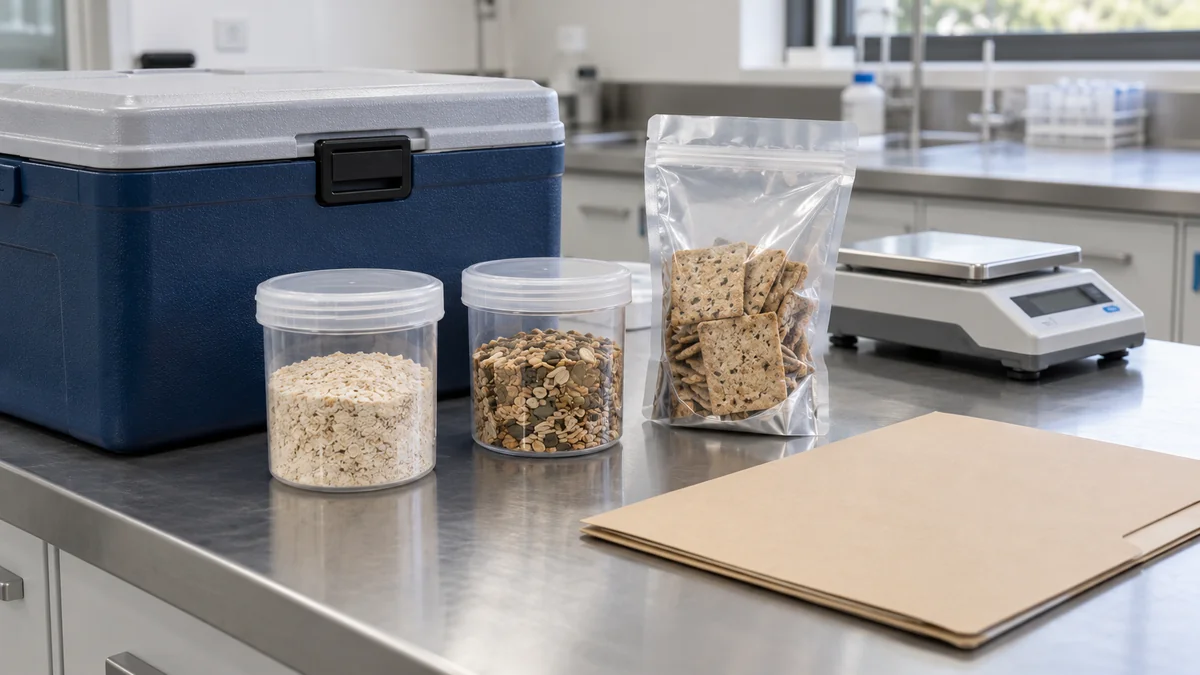
Before collecting anything, obtain the laboratory’s instructions for quantity, containers, preparation, storage and transport. Keep the batch references and identify who selected the food. If a sample no longer matches the agreed product or handling instructions, tell the laboratory before treating its report as the intended evidence.
Build a brief the laboratory and label reviewer can share
Use the following fields as a recommended starting point. Complete them with the laboratory before submission. The table is not a prescribed regulatory form or a replacement for the laboratory’s acceptance requirements.
On a small screen, swipe sideways to view all columns.
When accreditation is relevant to the intended use, check the actual scope. IANZ explains chemical-testing accreditation scopes by sample type, analyte and test method or technique. A general accreditation statement is not enough information to identify the coverage of your proposed work. Ask the laboratory to identify the applicable scope and any work outside it.
Review the report before entering panel values
Begin with identity: does the report name the correct sample, batch and product version? Check the reported sample condition, preparation and any qualifications against the brief. Keep the final report version together with the submission record so a later reviewer can follow the connection.
Next, reconcile the reporting basis. A result expressed per 100 grams is not the same presentation as a result per serving or per 100 millilitres. A dry-matter result also needs its basis resolved before it is used for the food as sold or consumed. Ask for a documented explanation of any conversion and the information used.
Use a simple handover list: nutrient name, laboratory result, units, food basis, intended panel field, conversion or calculation, and reviewer question. Record the original result alongside the reviewed value. Avoid an unexplained spreadsheet column containing numbers with no unit or source.
The Code’s panel rules distinguish serving and unit quantities, require prescribed information and address how values are expressed. Do not paste the laboratory’s rounding or report layout directly into artwork without the panel review. Confirm who will check the relevant Code provisions, serving information and proposed claims.
Close missing data and retain the results handover
If the report omits a requested nutrient, uses a different basis or contains a qualifier you do not understand, keep the question open. Ask the laboratory what was measured, what the notation means and whether further information or suitable additional work is needed. Do not insert a guessed number to complete the panel.
Unexpected differences from a prior calculation should lead to a documented review. Check the product identity, ingredient evidence, sample selection, processing information, methods and units before deciding what the difference means. Keep both sets of evidence; choosing whichever result best suits the artwork does not explain the discrepancy.
For a proposed claim, send the complete wording and report to the person reviewing the applicable claim conditions. A measured value alone does not answer every question about whether the wording is permitted. Do not treat a laboratory report as general approval of the product or its label.
A practical handover checklist
- Identify the product, formulation, production and artwork versions being assessed.
- Attach the agreed brief, sampling rationale and submission details.
- Retain the laboratory report and answers to technical questions.
- Record how the report basis and units connect with the intended panel.
- Assign responsibility for unresolved values and the label review.
- Save the reviewed panel, decision record and source documents together before releasing revised artwork.
Common nutrition-testing brief mistakes
- Ordering a familiar package without agreeing which nutrients and deliverables it includes.
- Sending a convenient development sample without explaining its relationship to commercial production.
- Leaving food preparation, drainage or reconstitution instructions out of the brief.
- Treating all results as though they have the same units and food basis.
- Replacing missing or qualified values with unsupported numbers.
- Assuming a report, a calculator output or a label review constitutes product approval.
Frequently asked questions
How AFVA can help with the nutrition evidence handover
AFVA’s food labelling review service includes nutrition information panels, servings information and marketing claims. It provides review comments and practical recommendations, with final label-compliance responsibility remaining with the food business.
For a useful enquiry, assemble the product specification, intended food form, proposed claims, draft artwork, laboratory brief, report and questions still unresolved. State whether you need help preparing the information for review or assessing a panel already produced. The engagement described here is consulting support, not a combined recognised verification or evaluation service.
Next step: Contact AFVA about your nutrition label evidence with the finished-product details and the decision you need the analysis to support.
General information only: Nutrition evidence and labelling requirements depend on the food, its composition, processing, presentation and claims. The suggested brief is not a universal test specification or proof of compliance. Use current official requirements and product-specific laboratory and regulatory advice.
Need Practical Food Safety Support for Your Business?
Contact us for free initial guidance. We provide practical, plain-English food safety support for New Zealand food businesses across all service areas.
This article provides general information only and is not a substitute for professional advice specific to your situation. Contact us for guidance based on your actual food activities and requirements.