
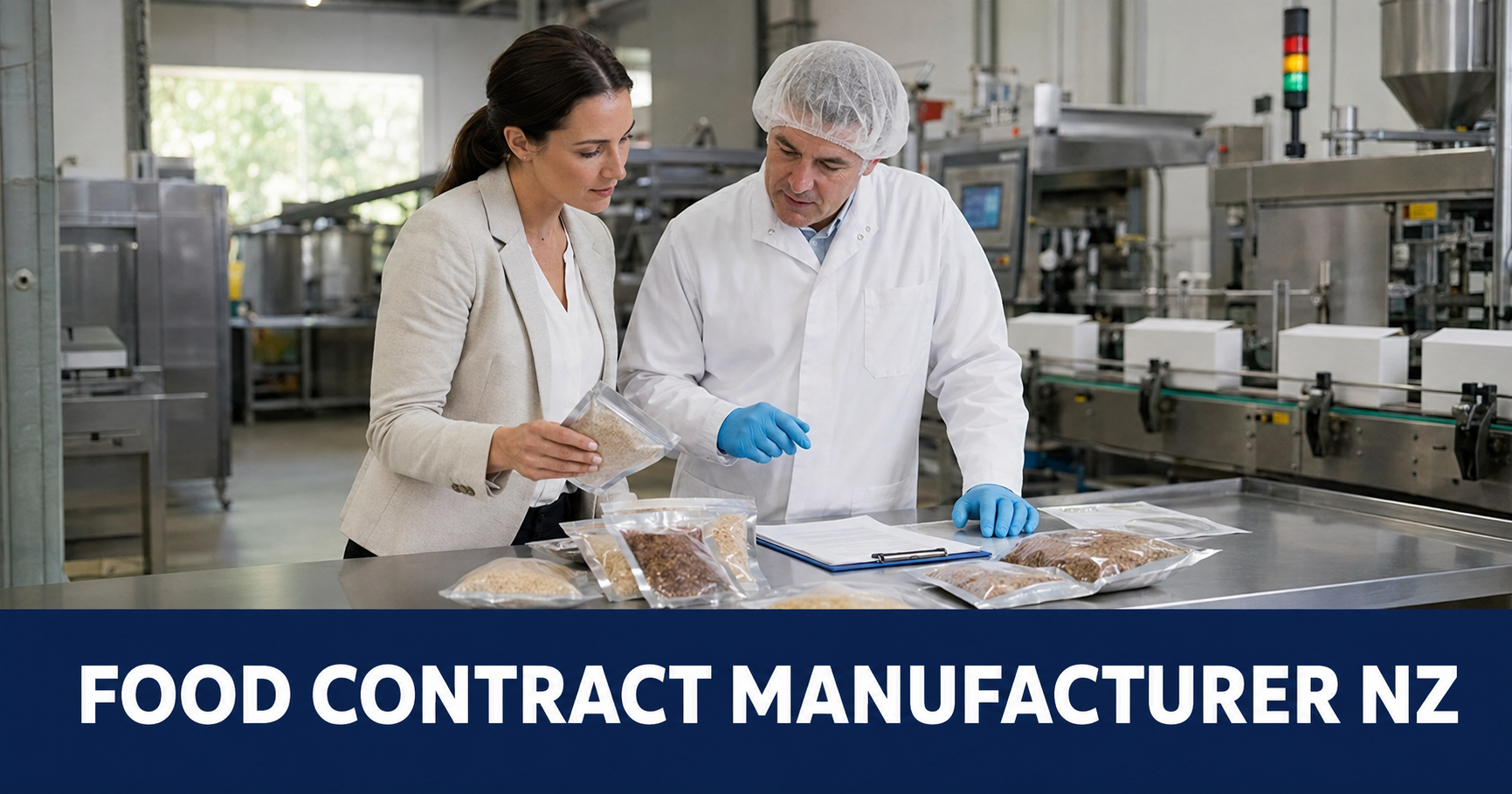
Need help finding or assessing a food contract manufacturer?
Access Food Verification & Auditing Limited (AFVA) provides practical food-safety, compliance and product-launch support for New Zealand food businesses.
Contact Access Food (AFVA) for Professional Support
We can help prepare or review your product specification, process and hazard information, label, shelf-life plan, supplier documentation, traceability requirements and manufacturer due-diligence evidence before commercial production begins.
Finding the right food contract manufacturer in NZ can turn a promising recipe into a consistent, scalable retail product. Choosing the wrong partner can lead to failed trials, unplanned costs, supply delays, allergen risks, label changes, quality disputes or a product that cannot achieve its intended shelf life.
The best manufacturer is not simply the company with available equipment or the lowest unit price. It is a business whose process capability, food-safety controls, scale, packaging options, technical systems, commercial terms and communication fit your product and market. This guide explains how New Zealand food brands, start-ups and established businesses can prepare, search, compare and select a suitable contract manufacturing partner.
Quick answer: how do you find a food contract manufacturer in New Zealand?
First define the product, ingredients, allergens, process, packaging, expected volumes, shelf life, target cost and market. Then identify manufacturers with suitable equipment and product-category experience. Compare their capacity, minimum order quantities, food-safety registration and certification, allergen controls, trial process, testing, traceability, quality systems, lead times and contract terms. Complete technical due diligence and a controlled production trial before approving commercial manufacture.
In this food contract manufacturing guide
- What contract food manufacturing means
- What to prepare before contacting manufacturers
- How to find suitable manufacturers in New Zealand
- Food-safety and technical due diligence
- Brand-owner and manufacturer responsibilities
- From bench sample to commercial production
- MOQs, costs and lead times
- What the manufacturing agreement should cover
- How AFVA can help
- Frequently asked questions
What Is a Food Contract Manufacturer?
A food contract manufacturer makes food on behalf of another business, normally under an agreed recipe, specification and commercial arrangement. The customer may own the brand and formula while the manufacturer supplies the premises, people, equipment, production controls and sometimes ingredient sourcing, packaging or distribution.
The terminology varies. Some companies describe themselves as co-manufacturers, co-packers, private-label manufacturers, white-label manufacturers or toll processors. These services are related, but they are not always the same.
| Term | Typical arrangement | Important point to confirm |
|---|---|---|
| Contract manufacturer | Manufactures your product to an agreed formula and specification. | Who owns the formula, process knowledge and improvements? |
| Co-manufacturer | Works collaboratively with the brand owner to scale and produce the product. | Who approves ingredients, changes, trials and product release? |
| Co-packer | Packs a product made by you or another supplier into the final format. | Product handling, coding, seal checks, label control and traceability. |
| Private label | A manufacturer produces an established or adapted product under your brand. | How much formulation, packaging and market exclusivity is available? |
| White label | A standard product is sold under multiple customer brands with limited changes. | Whether competitors may sell the same or a very similar formulation. |
| Toll manufacturing | The customer supplies some or all materials and pays for processing. | Ownership, loss allowances, yields and responsibility for supplied materials. |
Do not rely on the service name alone. Ask exactly which activities the manufacturer will perform—from formulation and ingredient purchasing through processing, testing, packing, storage and dispatch—and document the agreed boundary.
What to Prepare Before Contacting a Contract Manufacturer
Manufacturers can assess a project faster when the brand owner provides a clear and realistic brief. A vague enquiry such as “Can you make my sauce?” does not give enough information to determine equipment fit, risk, cost or capacity. A manufacturer-ready brief also makes quotations easier to compare.
| Information to prepare | What it should explain | Why it matters |
|---|---|---|
| Product description | Food type, intended consumer, intended use, storage and sales market. | Sets the technical and regulatory context. |
| Formula or ingredient list | Ingredients, percentages, processing aids, allergens and acceptable substitutions. | Supports costing, sourcing, allergen review and scale-up. |
| Process outline | Key steps, times, temperatures, pH, water activity, cooling or other controls. | Determines equipment fit and process safety. |
| Target specification | Sensory, physical, chemical, microbiological and weight requirements. | Defines what an acceptable finished product is. |
| Packaging format | Pack material, dimensions, closure, coding, case configuration and pallet needs. | Confirms line compatibility and packaging costs. |
| Shelf-life target | Proposed period, storage conditions, distribution and supporting evidence. | May affect process, formulation, packaging and testing. |
| Expected volumes | Trial quantity, first order, monthly forecast and growth assumptions. | Shows whether the project fits minimum and efficient run sizes. |
| Commercial requirements | Target unit cost, launch date, channels, customer standards and export plans. | Prevents technical work on a commercially unsuitable model. |
If the recipe is still at kitchen scale, it may not transfer directly to commercial equipment. Mixing order, heat transfer, shear, evaporation, cooling rate, ingredient functionality and filling conditions can all change at scale. AFVA’s new food product development support can help organise the food-safety and compliance information required before manufacturer discussions progress too far.
How to Find a Food Contract Manufacturer in NZ
Search by both product category and process. “Sauce manufacturer,” “bakery contract manufacturer,” “powder blending,” “retort processing,” “frozen food co-manufacturer,” “beverage co-packer” or “private label supplements” may identify a better fit than one broad search. Relevant trade associations, ingredient and packaging suppliers, food technology networks, industry contacts and the ManufacturingNZ Contract Manufacturing Directory can also help identify candidates.
Build a shortlist based on genuine capability, not marketing wording. A manufacturer may make a broadly similar product but lack the exact heating, cooling, mixing, allergen segregation, filling, metal detection, packaging or storage controls your product needs.
Questions to ask during the first discussion
- Do you currently manufacture this type of food or use this process?
- What are your minimum batch size, minimum order quantity and efficient run size?
- Can your equipment handle the ingredients, viscosity, particulates and packaging format?
- Which allergens are present in the facility, and how are changeovers controlled?
- Which ingredients and packaging can you source, and which must the customer supply?
- What development, trial, setup, testing, storage and waste charges apply?
- What is the usual lead time for trials and commercial production?
- Which food-safety registration, risk-based measure and certifications apply to the site?
- Can you meet the intended retailer, customer or export requirements?
- What technical information is provided with each batch?
Protect confidential information
Share enough information for an initial capability assessment, but consider a suitable confidentiality agreement before disclosing detailed recipes, processing knowledge, customer information or other commercially sensitive material. Obtain legal advice for intellectual-property and contract wording where needed.
Food-Safety and Technical Due Diligence
A certificate is useful evidence, but it is not a substitute for product-specific due diligence. Review whether the certificate is current, issued by an appropriate body, covers the correct site and includes the product and process within scope. Then assess the controls most relevant to your product.
New Zealand food businesses need to operate under the applicable regulatory requirements. MPI’s starting a food business guidance explains the general pathway for identifying food-safety rules and registration. The correct arrangement for a contract manufacturer and brand owner depends on their actual activities, product, location and supply chain.
| Due-diligence area | Evidence to review | Product-specific question |
|---|---|---|
| Regulatory status | Registration details, applicable Food Control Plan, National Programme, RMP or other measure, and verification status. | Is this product and process covered? |
| Certification | HACCP, ISO 22000, FSSC 22000, BRCGS, SQF or customer audit certificates and reports where relevant. | Does the scope match the site, product and process? |
| HACCP and process control | Process flow, hazard analysis, validated controls, monitoring, corrective action and verification. | Are the critical product and process risks controlled? |
| Allergen management | Site allergen map, scheduling, segregation, cleaning validation, rework control and label verification. | Could undeclared allergen cross-contact occur? |
| Supplier approval | Approved-supplier criteria, ingredient and packaging specifications, certificates and change controls. | Who approves suppliers and substitutions? |
| Traceability and recall | Batch coding, material-to-finished-product traceability, reconciliation, recall plan and mock recall results. | Can affected stock and customers be identified quickly? |
| Testing and release | Sampling plans, methods, specifications, certificates of analysis, hold-and-release and out-of-specification procedure. | Who can release or reject each batch? |
| Site standards | Cleaning, environmental monitoring where relevant, pest control, foreign-material controls, maintenance, calibration and staff training. | Are controls suitable for the product risk? |
| Business continuity | Capacity, preventive maintenance, backup arrangements, contingency plans and supply-risk controls. | What happens if a key line or supplier is unavailable? |
For a high-risk, technically complex or commercially important product, a document review may not be enough. A focused supplier audit can confirm whether written systems are implemented in practice. AFVA provides supplier audit and supplier approval support for New Zealand food businesses.
Who Is Responsible: the Brand Owner or the Manufacturer?
Outsourcing production does not mean outsourcing every responsibility. The manufacturer controls what happens at its site, while the brand owner usually controls the product concept, market presentation, customer commitments and many approval decisions. Some responsibilities are shared and must be clearly allocated.
| Activity | Typical manufacturer role | Typical brand-owner role | Must be agreed? |
|---|---|---|---|
| Formula and specification | Confirms manufacturability and controls approved production version. | Defines and formally approves product requirements. | Yes |
| Ingredient sourcing | Purchases from approved suppliers and verifies receipt. | Approves specifications, restricted ingredients and substitutions. | Yes |
| Production controls | Implements its food-safety plan, process controls and records. | Reviews evidence needed to confirm product requirements are met. | Yes |
| Label and claims | Provides accurate recipe, allergen, process and pack information; controls correct artwork use. | Approves legal name, label content, claims and final artwork. | Yes |
| Shelf life | Supplies process, packaging, production and testing evidence. | Approves the declared shelf life and market storage instructions. | Yes |
| Batch release | Completes production checks and release documentation. | Reviews agreed evidence or manages delegated release. | Yes |
| Complaints and incidents | Investigates production, raw-material and packaging causes. | Collects market information and coordinates customer response. | Yes |
| Traceability and recall | Traces ingredients, packaging, processing records and finished batches. | Traces distribution and customers and participates in recall decisions. | Yes |
MPI’s food recall guidance for businesses specifically recognises situations involving manufacturers and brand owners. The parties should agree how potential incidents are reported, who contacts MPI and customers, who controls public communication, how stock is identified and who pays recall-related costs. Recall contact details must work outside normal production meetings—food incidents rarely wait for a convenient time.
From Bench Sample to Commercial Production
A kitchen sample, pilot batch and full production run are different stages. Treating the first commercial run as the product-development trial creates unnecessary risk. Use a staged process with written acceptance criteria and formal approval points.
| Stage | Main activity | Evidence to capture | Approval point |
|---|---|---|---|
| 1 | Technical brief and feasibility review | Formula, product specification, process concept, pack and forecast. | Capability accepted |
| 2 | Costing and commercial review | MOQ, setup, labour, materials, testing, storage, waste and freight costs. | Commercial model accepted |
| 3 | Bench or development sample | Sensory result, formulation version and technical observations. | Target sample approved |
| 4 | Pilot or factory trial | Actual inputs, yields, losses, process settings, control results and samples. | Process technically accepted |
| 5 | Product and packaging assessment | Specification results, seal integrity, coding, transport and storage checks. | Product and pack approved |
| 6 | Shelf-life study | Defined samples, storage, microbiological or quality results and sensory records. | Date mark supported |
| 7 | Label and document approval | Final recipe, allergen data, nutrition information, claims, date mark and artwork. | Controlled artwork released |
| 8 | First commercial run and review | Complete batch record, release results, retained samples, yield and deviations. | Commercial release |
The factory trial should create evidence, not only samples. Record the exact ingredient lots and quantities, processing parameters, actual yield, hold times, temperatures, pH or water activity where relevant, cooling profile, pack checks, coding, deviations and test samples. If the process includes a critical control, the control and critical limit should be supported by suitable validation. AFVA can provide HACCP and food-safety plan support where the product or process needs a structured hazard review.
Do not print final labels too early
Commercial scale-up can change ingredient declarations, compound ingredients, allergens, nutrition values, net contents, storage instructions or shelf-life wording. Finalise the formula and process before releasing large volumes of packaging. AFVA’s food labelling review service can check key label information before printing or launch.
The shelf life should also be based on evidence relevant to the final commercial product, process and packaging—not only an earlier kitchen sample. See AFVA’s shelf-life testing support for study planning, laboratory coordination and documentation.
Minimum Orders, Costs and Lead Times
A manufacturer’s minimum order quantity, or MOQ, is often determined by equipment size, changeover time, ingredient pack sizes, packaging purchases and economic production speed. The smallest possible batch may cost far more per unit than the efficient batch. A low MOQ is not automatically better if setup charges, waste or material costs make the product uncommercial.
Ask for a transparent quotation that identifies:
- development, formulation and trial fees;
- setup, cleaning and changeover charges;
- ingredient, packaging and label costs;
- minimum purchase quantities and ownership of unused materials;
- manufacturing or conversion cost per batch and per unit;
- routine and non-routine testing costs;
- storage, pallet, handling and freight charges;
- expected process loss, giveaway, rework and waste;
- price-review rules and notice periods; and
- payment terms and deposit requirements.
Lead time should be divided into development, material procurement, artwork or packaging production, trial booking, test-result waiting periods and commercial production. Imported ingredients or custom-printed packaging may be the longest part of the timeline. Build contingency into the launch plan rather than promising customers a date based only on the factory run.
What Should a Food Manufacturing Agreement Cover?
A quotation confirms price; it rarely manages the full relationship. Use an appropriate written agreement and obtain legal advice where needed. Technical and quality requirements may sit in a separate quality agreement, product specification or schedule, but the documents should work together without conflicting instructions.
| Agreement area | Points to define | Risk reduced |
|---|---|---|
| Scope and specifications | Products, services, approved formulas, process, packaging and acceptance criteria. | Unclear deliverables |
| Intellectual property | Formula, process knowledge, artwork, tooling, improvements, confidentiality and permitted use. | Ownership disputes |
| Materials and suppliers | Approved sources, substitutions, minimum purchases, customer-owned stock and obsolescence. | Unexpected changes and stranded stock |
| Change control | Written approval before formula, ingredient, supplier, process, site, test or packaging changes. | Unapproved product variation |
| Quality and release | Checks, testing, certificates, retained samples, deviations, release authority and rejected goods. | Release of unsuitable product |
| Records and access | Record content, retention, document sharing, audit rights and regulatory access. | Missing evidence |
| Incidents and recalls | Notification time, contacts, decision roles, traceability data, communication and cost allocation. | Delayed or confused response |
| Forecasts and supply | MOQ, forecasts, firm orders, capacity, lead times, shortages and business continuity. | Supply failure |
| Commercial terms | Pricing, reviews, payment, waste, freight, title to goods, insurance and liability. | Unexpected cost and liability |
| Exit and transition | Termination, remaining stock, tooling, technical-file return, transition support and confidentiality. | Brand lock-in and disrupted transfer |
Common Contract Manufacturing Mistakes
- Choosing on unit price alone: a cheaper quote may exclude trials, tests, waste, packaging, storage or freight.
- Starting without a controlled specification: both parties may have different ideas of an acceptable product.
- Assuming a home recipe will scale directly: commercial equipment changes heat, shear, timing and yield.
- Not checking the certification scope: a certificate may not cover the site, process or product category.
- Ignoring allergens at the facility: shared lines and cleaning limitations can affect claims and consumer safety.
- Printing packaging before scale-up: the final commercial recipe or instructions may differ.
- Using an unsupported shelf life: manufacturer experience with another product is not automatically evidence for yours.
- Failing to control substitutions: an ingredient or supplier change may affect allergens, labels, claims, quality or shelf life.
- Unclear batch release: product can be dispatched before agreed results or approvals are complete.
- No recall interface: the manufacturer traces production while the brand owner traces distribution, leaving a gap between them.
Good operating practice supports the everyday controls needed to produce safe and suitable food. MPI provides general Good Operating Practice guidance, while the exact controls required depend on the food and operation.
How AFVA Can Support a Contract Manufacturing Project
AFVA does not present itself as the factory making your product. We provide practical food-safety, quality and compliance support that can help a brand owner become manufacturer-ready, evaluate technical gaps and prepare for a controlled product launch.
Depending on the project, support may include:
- product and process information review;
- product specification development or review;
- ingredient, allergen and supplier-document review;
- process-flow and HACCP review;
- manufacturer questionnaire, approval criteria or technical due diligence;
- supplier audit support where appropriate;
- factory-trial food-safety and documentation review;
- food label and claim review before printing;
- shelf-life study planning and laboratory coordination;
- traceability, batch coding and recall-readiness review;
- quality agreement input on technical responsibilities; and
- pre-launch compliance gap assessment.
Important independence note
Consulting, recognised evaluation and verification are different services. Independence or conflict-of-interest requirements may prevent the same person or organisation from providing certain recognised services after consultancy work. AFVA can explain the applicable separation before the scope is agreed.
Preparing to Approach a Food Contract Manufacturer?
Contact AFVA for free initial guidance. We can help identify the food-safety, specification, labelling, shelf-life and supplier-assurance information your project may need before commercial production.
Contact AFVA Product Development SupportFrequently Asked Questions
What is a food contract manufacturer?
A food contract manufacturer produces food for another business under an agreed formula, specification and commercial arrangement. The customer commonly owns or markets the brand, while the manufacturer supplies the production site, people, equipment and operating controls.
How do I find a food contract manufacturer in New Zealand?
Search by the product category and required process, ask relevant industry and supply-chain contacts, use manufacturing directories and prepare a clear technical brief. Shortlist only manufacturers whose equipment, scale, food-safety systems, packaging and commercial model fit the project.
What is the difference between contract manufacturing and private label?
Contract manufacturing commonly involves producing a customer-owned or customer-approved formula. Private label may use a manufacturer’s existing formula with customer branding or agreed modifications. The actual ownership, exclusivity and change rights should be confirmed in writing.
What is a minimum order quantity?
A minimum order quantity, or MOQ, is the smallest order a manufacturer will normally accept. It may be driven by tank or line size, changeover time, ingredient pack sizes, packaging minimums and efficient production speed.
What documents should I give a food manufacturer?
Useful documents include a product brief, controlled recipe, ingredient and allergen information, process outline, finished-product specification, packaging requirements, proposed shelf life, forecast volumes, target market and applicable customer or certification requirements.
Who is responsible for the food label?
Responsibilities should be allocated in the agreement. The manufacturer should provide accurate ingredient, allergen, process and packaging information and control approved artwork in production. The brand owner commonly approves the final label and claims used for its market.
Does a contract manufacturer set the shelf life?
A manufacturer may provide experience and supporting production information, but the declared shelf life should be justified for the final product, process, packaging, storage and distribution conditions. The parties should agree who plans testing, reviews results and approves the date mark.
Should I audit a food contract manufacturer?
The level of due diligence should reflect product risk, complexity, supply importance, available certification and customer expectations. A supplier questionnaire and document review may be sufficient in some cases; higher-risk or critical arrangements may justify an onsite supplier audit.
Who manages a food recall for a contract-manufactured product?
Both parties may have essential information and responsibilities. The manufacturer normally holds ingredient and production traceability, while the brand owner may hold distribution and customer information. The recall plan and agreement should define notification, decision, communication, records and cost responsibilities.
Can AFVA find a contract manufacturer for my food product?
AFVA’s core role is food-safety, quality and compliance support rather than operating as a manufacturing marketplace. We can help prepare manufacturer-ready technical information, assess documentation and food-safety gaps, support supplier due diligence, review labels and plan shelf-life evidence.
General information only: Requirements vary by product, ingredients, processing, packaging, activities, market and contractual arrangement. Confirm the requirements that apply to your specific business with the relevant authority and obtain legal advice for commercial contracts and intellectual property where needed.
Need Practical Food Safety Support for Your Business?
Contact us for free initial guidance. We provide practical, plain-English food safety support for New Zealand food businesses across all service areas.
This article provides general information only and is not a substitute for professional advice specific to your situation. Contact us for guidance based on your actual food activities and requirements.