
Are doubtful thermometer readings leaving a gap in your records? Explore AFVA’s food safety and quality consulting or contact AFVA for free initial guidance about your measuring-equipment procedure and evidence.
Food thermometer accuracy checks help a New Zealand food business decide whether an instrument remains suitable for its temperature-monitoring task. The useful evidence connects the instrument, checking method, actual result, acceptance criterion and action. A tick marked “calibrated” may leave all of those questions unanswered.
This guide is for managers and quality teams reviewing a food probe, a temperature record or an equipment-checking procedure. It does not set one checking frequency, tolerance or calibration service for every food control plan, national programme, risk management programme or process.
Quick answer: Identify what the thermometer is used to measure and the requirements applying to that task. Follow a suitable written checking or calibration method and the manufacturer’s instructions, compare the actual result with the applicable criterion, and record the decision and follow-up. If reliability is in doubt, control its use and review the monitoring evidence that could be affected. A simple ice check is not an accredited calibration certificate or proof of accuracy across every operating temperature.
Food thermometer accuracy checks start with the actual task
Write down what the instrument is used for: the food or environment, process step, relevant temperature range and decision supported by the reading. Identify whether the procedure needs a food-core, surface, air or other measurement. Use the method specified for that task rather than treating different kinds of readings as interchangeable.
Check the model and probe arrangement against the manufacturer’s instructions. Consider the stated range and accuracy, display resolution, response time, sensing area, immersion requirements, cleaning instructions and operating conditions. A display showing a decimal place does not, by itself, establish accuracy to that decimal place.
Keep a stable identity for each device. A simple equipment number can link the physical thermometer to its instructions, checks, calibration reports, repairs and use in monitoring records. Where a separate probe, lead or display forms a measuring system, identify the combination that was assessed. Substituting a component can leave the original evidence inapplicable.
Infrared instruments need their own suitable method. The New Zealand Measurement Standards Laboratory’s overview of infrared thermometer calibration highlights effects from emissivity, reflections and the instrument’s own temperature. Do not assume that a contact-probe checking method establishes an infrared instrument’s performance.
Separate an accuracy check, calibration and adjustment
Food guidance sometimes uses “calibration” as the heading for practical checks. Keep the operation itself clear in your procedure and record:
- A routine accuracy check compares the thermometer’s indication with a suitable known reference or comparison method and assesses it against stated criteria. Record what was actually done.
- Calibration establishes the relationship between indications and measurement-standard values under specified conditions, with measurement uncertainty, and supports deriving measurement results from those indications.
- Adjustment changes the instrument so its indications correspond to prescribed values. It is a separate operation from measuring how the instrument performs.
The International Vocabulary of Metrology definition of calibration distinguishes calibration from adjustment and verification. Its definition of adjustment also explains why further calibration is usually needed after an adjustment. Follow the appropriate equipment and technical instructions rather than changing a setting simply to make a check look acceptable.
An in-house check may be useful evidence within the business’s system. It does not become an accredited laboratory calibration because the form is called a calibration log. If an applicable requirement calls for accredited calibration, confirm the provider’s current scope for the instrument, range and service needed. This article does not claim that AFVA supplies accredited thermometer calibration.
Choose a checking method and criterion before taking the reading
Find the requirement in the current plan, programme, process procedure or customer or scheme specification that applies to your operation. Read it with the manufacturer’s instructions. Identify who is competent to resolve a mismatch or choose an appropriate method when the available documents do not answer the question.
MPI’s food safety toolkit distinguishes supporting guidance from the rules in the food control plan. Its linked thermometer calibration factsheet illustrates ice-slurry, boiling-water and comparison-with-a-calibrated-thermometer approaches. These illustrations do not create one universal checking programme for every business.
Make the method specific enough to repeat
AFVA recommends identifying the method reference and version, preparation of the reference, instrument position, relevant immersion and stabilisation instructions, result to record and acceptance rule. For a comparison method, identify the reference instrument and evidence that it is suitable for the comparison. Two devices agreeing does not resolve whether the reference is reliable.
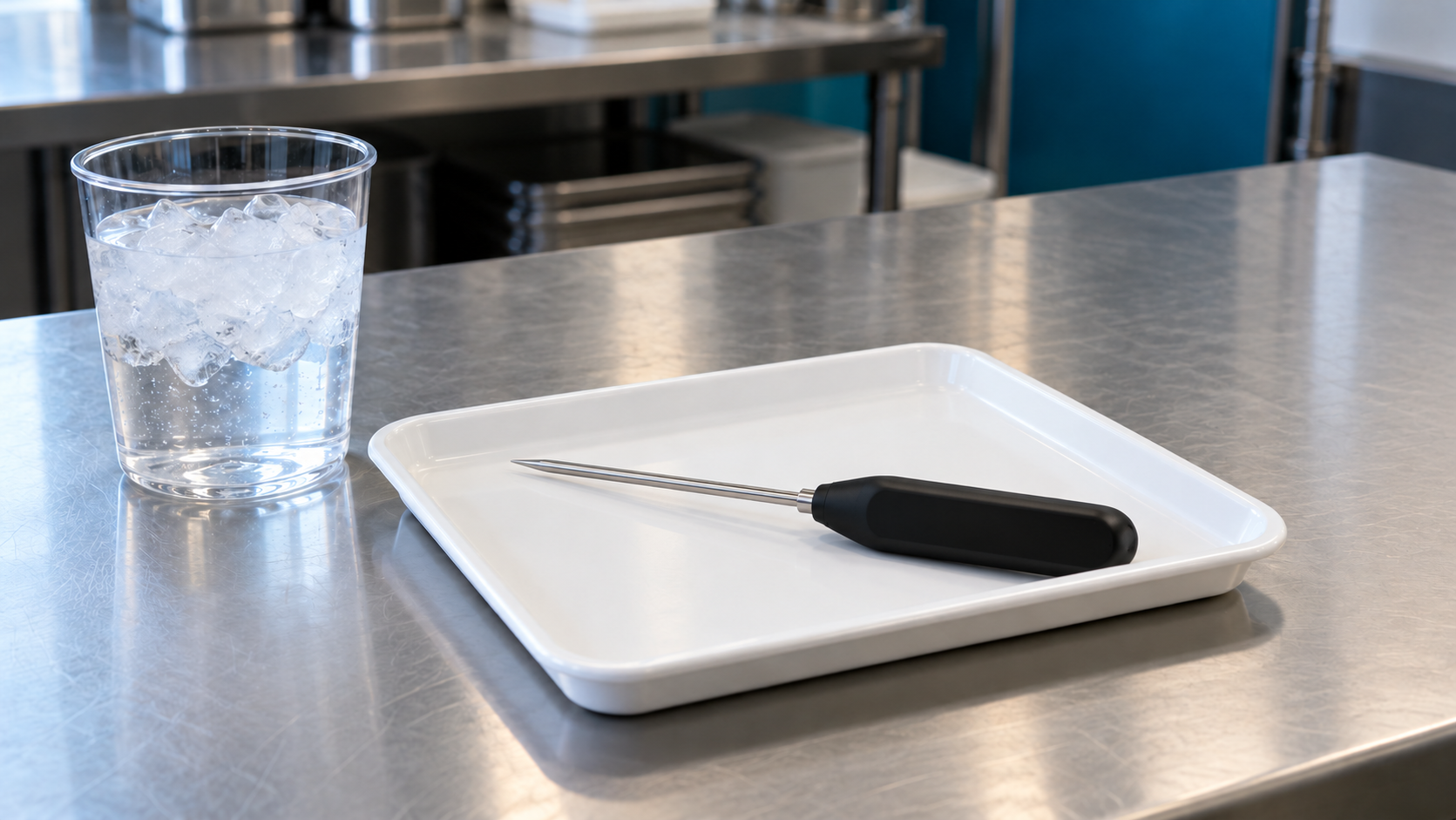
A properly prepared ice-slurry check and a glass of chilled water are different conditions. Follow the actual method, including its instructions to avoid the container’s sides and bottom. Do not improvise a check while trying to decide whether a critical monitoring result can be trusted.
For a hot-point check, use a method appropriate to the equipment and local conditions. The NIST guidance on thermometer verification explains that the boiling point depends on elevation and barometric pressure. Do not assume that boiling water provides the same reference temperature at every location. Protect staff from hot-water and steam hazards, and use competent technical help where the method or instrument requires it.
The acceptance criterion needs to suit the measurement decision. A check at one point does not establish performance across the full range used in the process. Where uncertainty, a correction or the closeness of a reading to a process limit matters, obtain competent advice on how those factors are handled. Do not silently subtract an assumed error from every earlier reading.
Set checking timing from the applicable requirements and use
There is no single interval proposed here for all New Zealand food thermometers. Identify any required interval in the actual documents applying to the business, then establish the checking programme appropriate to the device and task. A general factsheet suggestion should not replace a more specific applicable requirement.
As practical triggers, AFVA recommends reviewing instrument status after a drop, damage, repair, adjustment, a relevant component change or an unexplained or unstable reading. Also consider changes in use or temperature range. Define what staff should do when a scheduled check is overdue or there is reason to doubt performance.
An annual service sticker and a daily food-temperature check answer different questions. Record when the equipment was assessed and when the food was measured. Arrange a suitable checked replacement if the normal instrument is unavailable; a missed equipment check does not become complete because someone has booked it for later.
Keep a record that supports an acceptance decision
Use any record required by your actual system. The structure below is an AFVA recommendation for making the evidence understandable; it is not a prescribed form or a claim that every suggested field is legally mandatory. Record the original observations, including an unsuccessful check, rather than only the final acceptable result.
Fictional worked example: A business’s cold-food probe procedure specifies an ice-slurry check and adopts the −1°C to +1°C range shown in MPI’s factsheet for that check. A probe reads +2.0°C. The example therefore records a failed check and follow-up. It does not recommend that tolerance for every instrument or establish a suitable criterion for another process.
On a small screen, swipe sideways to view all columns.
For a comparison or external calibration, retain the reference or report identity and relevant results. Where applicable, include the temperatures assessed, correction, uncertainty, conditions and acceptance decision. Link the report to the device instead of filing an unidentified certificate that staff cannot connect to the instrument in use.
Respond when the instrument or earlier evidence is unreliable
First prevent doubtful readings from continuing to drive food decisions. Follow the business’s equipment and corrective-action procedure: identify the problem, control the instrument’s use, inform the responsible person and arrange a suitable replacement or assessment. Preserve the original check result and any information about damage or recent changes.
- Confirm the equipment issue. Check the method, device identity, reference and conditions. A poorly performed check and a faulty thermometer need different corrections. Do not repeatedly test until one result happens to pass.
- Define potentially affected monitoring. Identify the device’s tasks, last reliable evidence, relevant time period, products, batches and original records. Record what can and cannot be established.
- Assess the consequence. A competent responsible person reviews the uncertainty against the actual controls, limits and other reliable evidence. Use the applicable product-hold, incident and escalation arrangements when needed.
- Record the separate decisions. Document instrument repair or replacement, review of monitoring evidence, affected-product decisions, responsible people and follow-up. Confirm the basis for returning equipment to use.
A failed instrument check does not automatically establish that food is unsafe or authorise its release, reprocessing or disposal. Equally, a later acceptable reading does not reconstruct an earlier food temperature. Obtain timely advice for the product and process where the evidence is insufficient; do not wait for routine paperwork review to resolve an active food safety concern.
A short measuring-equipment procedure review checklist
- The instrument register matches the devices and combinations actually used.
- Each monitoring task has a suitable method, range and acceptance basis.
- Current equipment instructions and applicable plan or programme requirements are accessible.
- Checking methods identify preparation, reference, reading and decision steps.
- Intervals and event triggers are clear, with responsibility for overdue or failed checks.
- Records link actual results and decisions to the instrument and checker.
- Staff know how to identify unavailable equipment and obtain a suitable replacement.
- The procedure explains who reviews potentially affected monitoring evidence and authorises follow-up.
Equipment performance and staff performance both matter. The separate guide to observing CCP-monitoring competence helps assess whether a person can follow an existing procedure and respond to a deviation. Use it alongside the equipment review, rather than treating a course certificate or an instrument sticker as the whole competence decision.
Common mistakes that leave gaps in the evidence
- Writing only “pass”. Keep the actual result, criterion, method and device identity.
- Applying a generic tolerance to every task. Check the actual requirement and measurement decision.
- Checking only at a convenient temperature. Consider whether the evidence covers the range used.
- Assuming two agreeing probes prove accuracy. Establish the reliability of the comparison reference.
- Adjusting without retaining the original result. Record what changed and the appropriate follow-up assessment.
- Replacing the thermometer without reviewing its use. Decide whether earlier monitoring evidence needs investigation.
- Inventing missing results. Record a gap honestly and assess its effect; never backdate a check.
Ask AFVA to review a defined procedure or record gap
AFVA’s consulting service includes maintenance and calibration records, temperature records and corrective-action support. For a measurement used within a HACCP control, AFVA’s HACCP consulting service includes reviewing monitoring, control measures and supporting evidence. This is procedure and evidence support; agree specialist calibration work separately with an appropriate provider.
Prepare the instrument’s model and identity, actual task, applicable requirement, current procedure, relevant reports and check results. Describe the doubtful reading, any affected products or records and actions already taken. A focused brief helps identify what can be reviewed and what needs additional technical input. For broader context, see the food safety compliance guide.
Frequently asked questions about food thermometer checks
Connect the instrument check to the food decision
Choose one instrument and one monitoring task. Trace the link from the applicable requirement and method to the latest result, acceptance decision and action. Resolve missing information before treating the check as evidence for a wider task or temperature range.
Need practical support? Contact AFVA about your measuring-equipment procedure and records. Include the task, device, relevant results and the decision that needs support.
General information only: Requirements depend on the actual food activities, products, processes, equipment and applicable plan, programme, customer and scheme conditions. Use current official guidance and manufacturer instructions, and obtain competent advice where needed. This article is not a calibration certificate or authority to release, reprocess or dispose of food.
Need Practical Food Safety Support for Your Business?
Contact us for free initial guidance. We provide practical, plain-English food safety support for New Zealand food businesses across all service areas.
This article provides general information only and is not a substitute for professional advice specific to your situation. Contact us for guidance based on your actual food activities and requirements.