
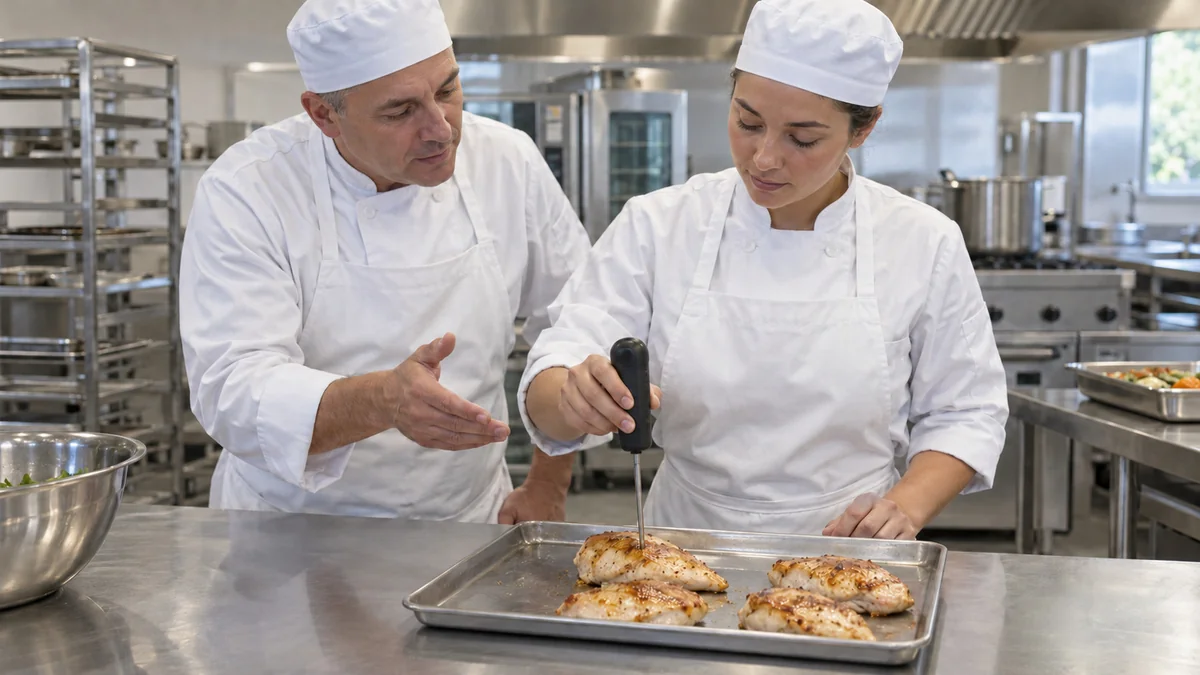
Turning HACCP learning into workplace practice? Explore AFVA's HACCP Foundation Training or contact AFVA for free initial guidance.
After HACCP training, a food manufacturer's next question is practical: can this staff member carry out the monitoring task described in our own plan, recognise a deviation and report it correctly?
This guide offers a recommended workplace observation record for a critical control point (CCP) already identified in your documented system. It is not a course-selection guide, a method for choosing critical limits or a decision on eligibility for a regulated role.
Quick answer: Do not use a course certificate alone as your workplace competence decision. We recommend observing the named task against the current procedure, checking how the worker interprets the result, rehearsing deviation reporting safely, and recording evidence and follow-up. Keep the conclusion specific to that task; the worksheet does not replace any qualification, supervision or other requirement that applies to the business.
HACCP training and workplace evidence answer different questions
AFVA's foundation course covers hazards, prerequisite programmes, HACCP principles, monitoring, corrective action and verification. Its assessment and completion information explicitly distinguishes the completion certificate from an NZQA qualification, organisational certification, auditor qualification or workplace practical competence assessment.
FSANZ's guidance on shaping food safety culture emphasises applying knowledge on the job, supportive two-way communication and assessing performance. This is practical guidance, not a New Zealand requirement to use the worksheet below.
The observation approach translates that guidance into a narrow question: what did the worker demonstrate on this task, and what still needs attention? For the broader training question, see AFVA's staff food safety training guide.
Prepare a task-specific observation
Use the following briefing checklist as a recommendation. Obtain the technical instructions from your own current system rather than creating a new monitoring method during the assessment.
- Define the task: identify the CCP, line, relevant product or product family and the duties being observed.
- Check the documents: locate the current procedure, monitoring record, documented limit or limits, and deviation instructions.
- Clarify the method: identify the specified equipment, measurement or observation location, units, timing and frequency. Where relevant, include equipment checks and hygiene instructions from the procedure.
- Clarify responsibilities: identify who monitors, who is contacted, and who makes affected-product and restart decisions.
- Choose the observer: use someone who understands this procedure well enough to recognise a mismatch and explain the required task.
- Plan safe practice: distinguish normal monitoring from any simulated exercise and agree how the observer will intervene if necessary.
Check applicable role requirements before allocating duties. For Food Act businesses, the current Food Regulations 2015 identifies competency and training provisions at regulation 31 for food control plans and regulation 77 for national programmes. Read the provisions relevant to your business alongside its plan or programme; this article does not determine those obligations or any sector-specific qualification requirements.
A worked structure for a CCP-monitoring observation record
Recommended record header: worker and observer names; observation date and shift; product, line and CCP; procedure title and version; equipment identity where relevant; and the linked monitoring-record reference.
The table shows how to turn a checklist into useful notes. Its example wording is illustrative, not a real staff assessment or client incident. Write what actually happened, including any prompts. Record an unobserved step as unobserved rather than assuming it was demonstrated.
On a small screen, swipe sideways to view all columns. Keyboard users can focus the table region and scroll horizontally.
Check the deviation response without creating a real failure
We recommend a discussion or simulation using a result outside the business's documented limit. Mark the exercise clearly as training. Do not deliberately compromise a live control or enter simulated results into genuine production records.
Ask the worker to find the procedure and explain:
- What action is assigned to them when this result occurs?
- Who receives the report, and what information is needed?
- How does the procedure identify and control potentially affected product?
- Who decides on product disposition, restart or further investigation?
- What records connect the deviation with the response?
These are briefing questions, not a universal corrective-action protocol. Do not teach a generic retest-and-release shortcut. Any real deviation, uncertain result or equipment problem should be handled through the business's applicable instructions and escalation process.
Record a limited conclusion and targeted follow-up
Useful internal observation categories are demonstrated without prompting, demonstrated with prompting, not yet demonstrated and not observed. These are suggested recording terms, not official grades or permission to work independently.
Describe the gap precisely. A worker who understands the limit but cannot locate the deviation contact needs different support from someone using the wrong measurement method. Record the agreed coaching, supervision and repeat observation rather than simply writing “more training”.
Choose a review point that suits the task and follow-up. Revisit the observation when relevant instructions, equipment or assigned duties change, or when evidence suggests a gap. This guide does not prescribe an annual interval. FSANZ's Know, Do, Follow through guidance supports tracking improvement rather than treating training as a one-off event.
Common mistakes to avoid
- A tick without evidence: add the observed action and any prompt, not just a pass mark.
- Memory replacing the procedure: check that the worker can locate and use the current instructions.
- One observation becoming a blanket sign-off: name the task and conditions actually covered.
- Changing limits during training: escalate unclear instructions for review rather than inventing an acceptance criterion.
- Practising reporting but ignoring product decisions: include the procedure's affected-product responsibilities.
- Assuming a staff check validates the process: assess the worker's performance without claiming the observation proves the underlying control is effective.
Frequently asked questions
Does passing AFVA's foundation course prove workplace competence?
No. AFVA explicitly describes its course certificate as a completion certificate, not a workplace practical competence assessment. Use the business-specific evidence and requirements relevant to the assigned task.
Is this an official CCP assessment form?
No. It is an AFVA-recommended internal observation structure. It does not replace applicable training, qualification, supervision or record requirements.
Should every CCP use the same observation checklist?
We recommend keeping a shared record structure while adapting the checkpoints to each procedure. Do not assume different equipment, products or monitoring methods involve identical tasks.
How can we check deviation response when no deviation occurs?
Use a clearly identified discussion or simulation based on your procedure. Record that it was simulated and distinguish explained actions from actions physically demonstrated.
What if the worker succeeds only after prompting?
Record the prompt and the specific gap. We recommend targeted coaching or supervision followed by another observation of that part of the task, rather than treating a prompted answer as unassisted performance.
Does this worksheet decide whether staff may monitor independently?
No. It supplies internal evidence about a named task. The business still needs to check the requirements and responsibilities applying to its plan or programme before allocating duties.
Practical AFVA support
AFVA's HACCP consulting and food safety plan support includes reviewing practical monitoring checks, staff understanding and supporting records. The service also includes practical HACCP awareness training and staff guidance. This is a consulting and training enquiry, not an offer of a combined consulting and recognised verification or evaluation engagement.
For a useful discussion, prepare the relevant procedure, monitoring form, assigned responsibilities and the particular task or reporting gap you want help with.
Start with one clearly defined task. Observe it, record the evidence and close the identified gap. Contact AFVA for free initial guidance on HACCP training or consulting support.
General information only: Requirements depend on the complete food activities, products, processes, locations and sales model. Use current official guidance and confirm the requirements applying to the specific business before relying on a classification, timeframe or record list. This recommended observation record does not establish critical limits, validate a control, approve product release or confer a qualification.
Need Practical Food Safety Support for Your Business?
Contact us for free initial guidance. We provide practical, plain-English food safety support for New Zealand food businesses across all service areas.
This article provides general information only and is not a substitute for professional advice specific to your situation. Contact us for guidance based on your actual food activities and requirements.