
Need help with this food safety decision? Review AFVA’s food safety compliance support or contact AFVA for free initial guidance.
A café supplying chilled meals to a shop, or a deli supplying tubs of dip to restaurants, can have different responsibilities from a business selling those products over its own counter. The new customer might resell the pack as supplied, open it and use it as an ingredient, or arrange distribution to several sites. Check the actual arrangement before committing to supply.
Quick answer. Compare the new wholesale activity with your registered scope and Food Control Plan (FCP). Take the product, buyer, process, pack, shelf life and transport details to your registration authority. Ask whether your current route covers it and what application, notice, evaluation or other action is required before you start. Separately check what food information the buyer and final consumer must receive.
Describe the order as it will actually work
Start with a single proposed product. Record who buys it and what they will do with it. A shop selling sealed packs to the public, a restaurant portioning food for immediate consumption and a manufacturer using a bulk ingredient represent different supply arrangements. Ask for a sample purchase order or a written account of the buyer’s intended use.
- Record the recipe, production site, current and proposed pack size, and whether the pack will be resold as supplied.
- Map what changes in production, from batch size and cooling to packing, storage, delivery and handover.
- Identify which party controls transport, accepts the shipment, manages any repacking and answers food-information questions.
- Attach your existing registration, scope and relevant plan pages. Mark which activities the new order introduces.
This brief makes a scope review possible even while some commercial terms are still open.
Check whether your current plan and registration still fit
Use MPI’s template Food Control Plan guidance to check whether all activities are covered by an available template. MPI’s custom Food Control Plan guidance identifies examples of high-risk foods manufactured for sale to other businesses, including meals, ready-to-eat salads and non-shelf-stable dips. Confirm the route using the actual activity, rather than assuming all wholesale sales have the same requirements.
If you already operate under a custom FCP, MPI’s custom-plan amendment guidance lists a change from retail to wholesale among significant amendments that may not require evaluation. Another change made at the same time can alter the assessment. For amendments to registered FCPs, sections 45 and 46 of the Food Act 2014 distinguish written notice for non-significant amendments from an application to register a significantly amended plan. The registration authority may require evaluation of a significant amendment to a custom plan. See AFVA’s custom Food Control Plan change guide if your processes or premises are also changing.
Confirm the label, shelf life and delivery separately
Standard 1.2.1 of the Australia New Zealand Food Standards Code distinguishes retail sale, food sold as suitable for retail without further processing, packaging or labelling, catering supply and other sales. Check which provisions apply to the sale. A purchase order described as wholesale does not settle the labelling route. Agree which information appears on the pack or accompanies the food as applicable. Check allergen information, storage and use directions, and lot identification against the actual product. Use AFVA’s packaged food labelling checklist when the pack is intended for retail.
Review whether your shelf-life evidence still fits the changed pack, storage and transport arrangement. Name who checks and records the condition at dispatch and receipt, and what happens if agreed requirements are missed. Link the lot to the delivery and recipient so you can identify affected stock if a problem arises. AFVA’s retailer technical questionnaire guide can help when the buyer requests documentary evidence.
Worked example: chilled meals for a shop
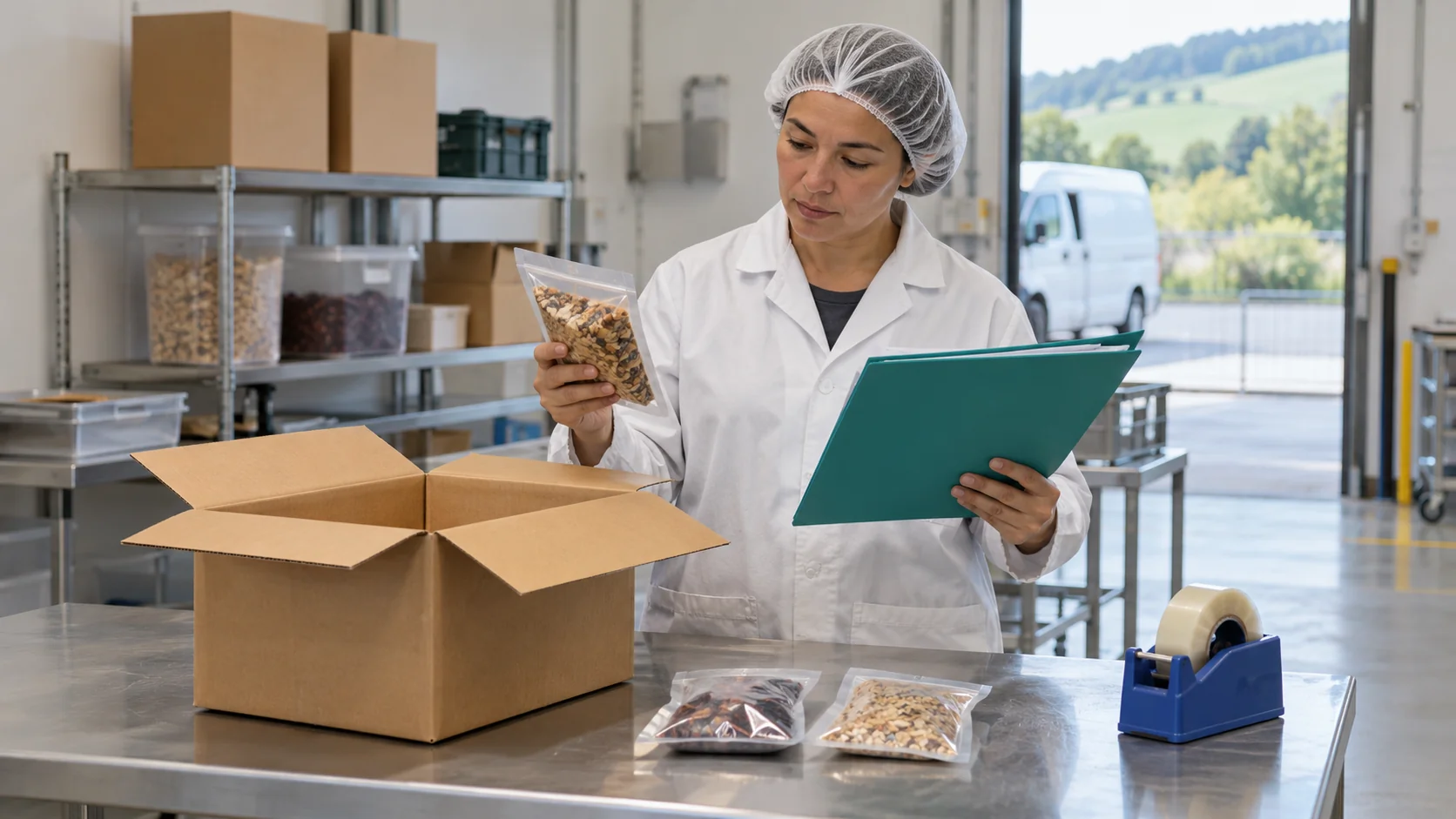
A café proposes making a larger batch of chilled meals, packing them in sealed retail trays and delivering them to a shop to sell unopened. Its existing plan describes sale through the café. The owner marks the change in customer and pack, checks how the larger batch will be cooled, and reviews shelf-life evidence for the tray and planned cold chain. They show their authority the proposed manufacturing, distribution and sale, confirm the applicable route and complete any required steps before supply. The buyer and supplier confirm label ownership, delivery acceptance and batch traceability in writing. These checks identify what the café must resolve. They do not determine the route for a different product.
Frequently asked questions
Can I take a trial order on my existing café registration?
Check whether the registered scope covers the trial activities. The small quantity or trial label does not determine the regulatory route. Resolve any required registration steps before supplying.
Does a wholesale change always require an evaluation?
MPI identifies some custom-plan retail-to-wholesale changes that may not require evaluation. Describe the complete change to the registration authority, including any new process, site or pack.
Can I use the shelf life I already give customers at my own shop?
Check that existing evidence covers the new product, pack, storage and transport. Changes in the conditions or intended use can require further technical work.
Does a business-to-business order need food information?
Yes, check the applicable Code provisions. The form of the required information depends on the food, packaging and sale, including whether the product is supplied ready for retail.
How AFVA can help
Contact AFVA with the existing registration, proposed products and first buyer’s intended use to discuss the food safety work needed for the wholesale change. Formal evaluation and verification are subject to recognised scope and independence.
General information only. Confirm the requirements that apply to your specific food activities, products, processes, locations and sales model.
Need Practical Food Safety Support for Your Business?
Contact us for free initial guidance. We provide practical, plain-English food safety support for New Zealand food businesses across all service areas.
This article provides general information only and is not a substitute for professional advice specific to your situation. Contact us for guidance based on your actual food activities and requirements.