
Need help with this food safety decision? Review AFVA’s food labelling review service or contact AFVA for free initial guidance.
A shipment has arrived in its overseas retail packaging. The importer has approved a New Zealand sticker, and a warehouse team is ready to apply it. The practical question is whether the sticker and the original pack, read together, will give customers the correct information before the food is offered for sale.
Quick answer. Start with a current supplier specification and a real pack from the affected lot. Check the sticker against the New Zealand requirements for the food, then inspect it on the finished pack. If it corrects incorrect information, the new label must stay in place and hide that information. Keep required information visible and pause release if the date mark, the product or the final label remains in doubt.
Check which issue you are trying to fix
A sticker may add missing information or correct information already printed on the package. Food Standards Code Standard 1.2.1 allows the required information to be provided through labels that together meet the relevant requirements. Section 1.2.1—22 generally prohibits defacing a package label without the relevant authority’s permission. Its specific correction provision allows a new label over incorrect information when the new label cannot be removed and the incorrect information is no longer visible. Section 1.2.1—24 requires prescribed words in English and the required content to be legible and prominent. Any other language present must not negate or contradict the English.
Treat this as a pre-sale check for packaged retail food. MPI’s importer assessment guidance distinguishes completing an assessment before the food arrives from adding compliant labelling before sale, where appropriate. A sticker check sits alongside any applicable border-clearance controls. For the whole shipment process, use AFVA’s first-shipment guide.
Inspect a physical pack before approving the batch
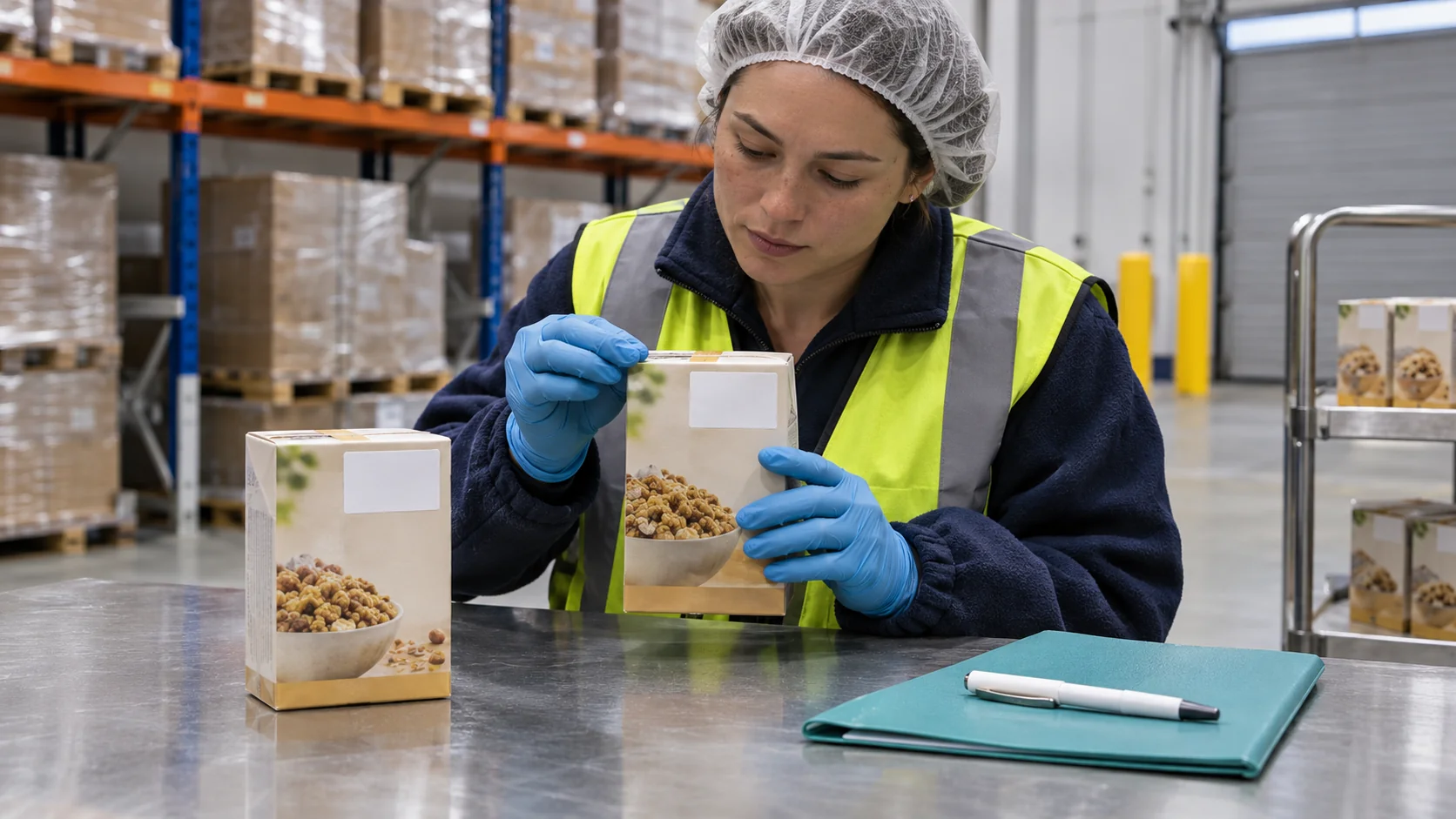
Check the sticker on the exact pack size, material and artwork version being processed. Use photos to capture the original and finished pack, including the sides, seams and any variable coding. Confirm that the sticker matches the current supplier specification for the lot. Use the food label review information checklist if you need to assemble the source material.
- Compare every field the sticker adds or corrects with the approved label proof and the supplier’s current information. Pay particular attention to required ingredient, allergen, warning and storage details.
- Check placement. The sticker must cover the incorrect content, and it should leave required information such as the lot identifier and date mark visible and readable. Check nearby text for conflicting statements.
- Test the finished sample under its intended handling conditions. A sticker that lifts, rubs off or becomes unreadable calls for a different label or method before the batch is released.
- Check each variant, language panel and pack size used in the job. Similar-looking versions are easy to mix up.
Keep date marks and safety issues on their own path
If the proposed sticker would cover, replace or extend an existing date mark, keep the affected stock out of sale and check the proposed action with MPI before altering the date. MPI’s retail labelling guidance directs businesses to its date-mark alteration process. A compliant correction to another label field does not itself settle a date-mark issue.
If you discover a potential safety issue, such as an undeclared allergen, pause sale and distribution and use your food safety incident process. If any affected stock has already left your control, act promptly using MPI’s recall guidance. A warehouse rework instruction on its own is insufficient for stock already supplied.
Use a lot-level release record
A practical record includes the product and lot, original pack revision, approved sticker revision, approved placement photo, quantities processed and held, any defects found, and who authorised release and when. In an illustrative job, a supplier has two identical-looking carton sizes and only one has room for the sticker without covering the lot code. The checker approves a separate placement photo for each size and keeps unverified stock on hold until the two versions can be reliably separated. Review AFVA’s general NZ food labelling guide for the wider retail label check.
Frequently asked questions
Can the overseas language remain visible?
It can remain where it does not negate or contradict the English and where the required labelling remains legible. Incorrect information being corrected under section 1.2.1—22 must be hidden.
Can I use the same sticker on several pack sizes?
Check each size against its own artwork and requirements. The wording may be suitable for several packs, but placement, legibility, visible original information and product details may differ.
Can a warehouse apply the over-label on behalf of the importer?
If you use a warehouse, give its team the approved proof, placement and hold instructions, then confirm the finished packs and quantities before release. The importer remains responsible for its obligations.
How AFVA can help
Bring photographs of all sides of the original retail pack, the supplier specification, the proposed sticker and the intended placement. AFVA can review the label information and help identify questions to resolve before the job proceeds.
General information only. Confirm the requirements that apply to your specific food activities, products, processes, locations and sales model.
Need Practical Food Safety Support for Your Business?
Contact us for free initial guidance. We provide practical, plain-English food safety support for New Zealand food businesses across all service areas.
This article provides general information only and is not a substitute for professional advice specific to your situation. Contact us for guidance based on your actual food activities and requirements.