
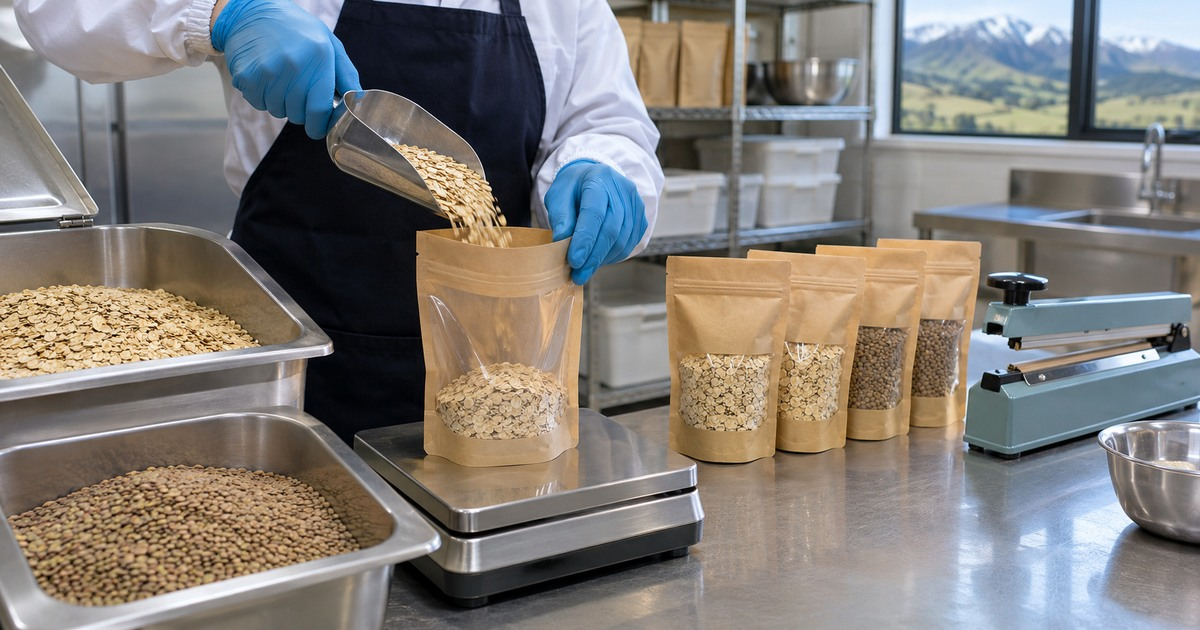
A shop buys a bulk sack of trail mix and fills smaller pouches for the shelf. Before the first pouch goes on sale, the shop needs to check that its registration covers repacking, that the new label tells customers what's inside, and that each pouch can be traced back to the supplier's lot. Opening the original sack can also change how long the food stays safe and suitable. MPI's National Programme 3 guidance · MPI's shelf-life guidance
Which food safety registration applies to retail repacking?
MPI lists repacking food for retail sale under National Programme 3 (NP3) for retailers that handle food without preparing or manufacturing it. That is the starting point if you buy finished food in bulk, portion it into smaller packs and sell those packs to consumers. Check your full operation in MPI's My Food Rules tool, particularly if you also blend ingredients, process food or pack for other businesses. If you're already registered, check that the new activity is covered before you start. MPI's guidance for retailers who handle food · MPI's My Food Rules tool
If NP3 applies, arrange written confirmation from an appropriately recognised verifier before applying to register. A business based in one council area generally registers with its local council. If you have fixed premises in more than one council area, you can register the sites with their respective councils or register them together with MPI. Arrange verification after registration. MPI's steps for NP3 · MPI's food business registration guide
What goes on the smaller retail pack?
Use the supplier's current product specification, ingredient and allergen information, and the original bulk label to prepare the new label. For a typical prepacked retail product, check the food name or description, lot identification, the supplier's name and business address in New Zealand or Australia, the ingredient list, allergen declarations, the date mark and any storage directions. Also check whether the product requires a nutrition information panel, percentage declarations for characterising ingredients, or other statements. Check the net quantity for the pack you actually sell. MPI's retail food labelling guide
Food packed in front of the customer can qualify for a label exemption. If you fill pouches in advance, check the rules for those packs separately. Where a label exemption applies, check how you must make required information, including allergen information, available to customers. MPI's retail food labelling guide
Declare allergens and control cross-contact
For retail packs requiring an ingredient list, use the names prescribed by the Australia New Zealand Food Standards Code. Where required, declare allergens in bold in the ingredient list and repeat them in a separate bold Contains statement next to it. For example, a trail mix containing almonds and cashews needs the required names for those nuts. Check the recipe and supplier specification before printing and whenever the supplier or formulation changes. MPI's allergen labelling guide
At the packing bench, check which scoops, scales and containers are shared. Set out how staff will clean equipment, separate products and check that the correct label goes on each run. A voluntary may contain statement addresses possible unintended presence. The required declaration still applies to allergens in the ingredients. MPI's allergen labelling guide · MPI's NP3 guidance
How do you date-mark food after repacking?
Check what shelf life the new pack can support. The supplier's date was set for the food in its original packaging under expected storage conditions. Ask the manufacturer for information that supports the date you intend to use after opening and repacking. Consider how long the bulk pack is open, how the food is handled and how well the new pack protects it. For example, a small pouch may offer a different moisture barrier from the sealed bulk sack. MPI's shelf-life guidance, section 8 · MPI's food packaging guidance
Where a date mark is required, apply the appropriate use-by or best-before date and any storage instructions needed to support it. A use-by date is about safety. A best-before date is about quality. Food past its use-by date must stay out of sale. If you intend to alter a date mark on an existing package, check MPI's date-mark alteration process before making the change. MPI's retail food labelling and date-mark guidance
Keep a traceable link from the bulk lot to the shelf
Give each repacking run a record that ties the supplier lot to the code on the finished packs. Record the supplier, incoming lot and original date mark, the date you opened and packed the food, the finished pack code and the quantity packed. If one run uses more than one supplier lot, record each one. Keep enough information to identify affected stock on site and where packs went if you distributed them to other outlets. Test that link in your simulated recall. MPI's NP3 sourcing, receiving and tracing guidance · MPI's simulated recall guidance
Talk to AFVA before your first packing run
Tell us what you buy in bulk, how you'll repack it and where the finished packs will be sold. Access Food Verification & Auditing Limited can help you check your registration scope, review draft labels and prepare your batch records for verification. Contact AFVA to discuss your repacking operation or request a quote. Contact AFVA
Need Practical Food Safety Support for Your Business?
Contact us for free initial guidance. We provide practical, plain-English food safety support for New Zealand food businesses across all service areas.
This article provides general information only and is not a substitute for professional advice specific to your situation. Contact us for guidance based on your actual food activities and requirements.