
Need help with this food safety decision? Review AFVA’s shelf-life testing support or contact AFVA for free initial guidance.
You already sell a chilled dip with an established date mark. A new supplier proposes a different vinegar, or purchasing finds a replacement tub. The product may look identical, but the original evidence describes the version you tested. A shelf-life reassessment gives you a documented reason to carry that evidence forward, or a clear question to test before the changed product goes on sale.
Quick answer. Compare the old and new product as actually manufactured, packaged and stored. Identify which safety and quality assumptions the change could affect, then decide what evidence you can still use and what needs to be checked. Keep the existing date and instructions for the changed product only when the evidence supports them.
Start with the version your shelf-life evidence covered
Pull the original study or justification and note the formulation, process, final pack and storage conditions it actually assessed. Look for the date-mark type, intended duration and the safety or quality result that limited it. If the file is missing, or if it describes a prototype rather than the current production version, record that gap before trying to justify a change. The general shelf-life testing guide explains how date marking and shelf-life evidence fit together.
Work out what the change could affect
Compare the versions line by line. MPI’s shelf-life guidance describes both product properties and external conditions that affect shelf life. Use these prompts as a review aid.
- Recipe — Compare the exact ingredients and amounts. A change in acid, salt, sugar or preservative may change a control that contributed to shelf life. Consider whether measurements such as pH or water activity are relevant to the decision.
- Pack — Compare the complete container, closure, dimensions, seal and any protective atmosphere. Ask how the changes could affect integrity, oxygen or moisture transfer, or the temperature history of the product. MPI’s packaging guidance specifically flags checking shelf life after some packaging changes. Keep separate evidence for packaging suitability.
- Process and distribution — Compare fill, treatment, cooling, storage and transport conditions where relevant. A larger unit or changed delivery arrangement can put the product outside the conditions used in the original study.
Decide what evidence closes the gap
Write one decision for each difference. If the evidence still applies, record why and state the limits of the decision. Where a specific uncertainty remains, agree a targeted check. If a change affects the basis of a safety control, or the earlier evidence cannot be matched to the new version, seek technical input on the study or validation needed before release. A check for colour or texture serves a quality purpose. A safety decision needs evidence relevant to the actual hazard and conditions.
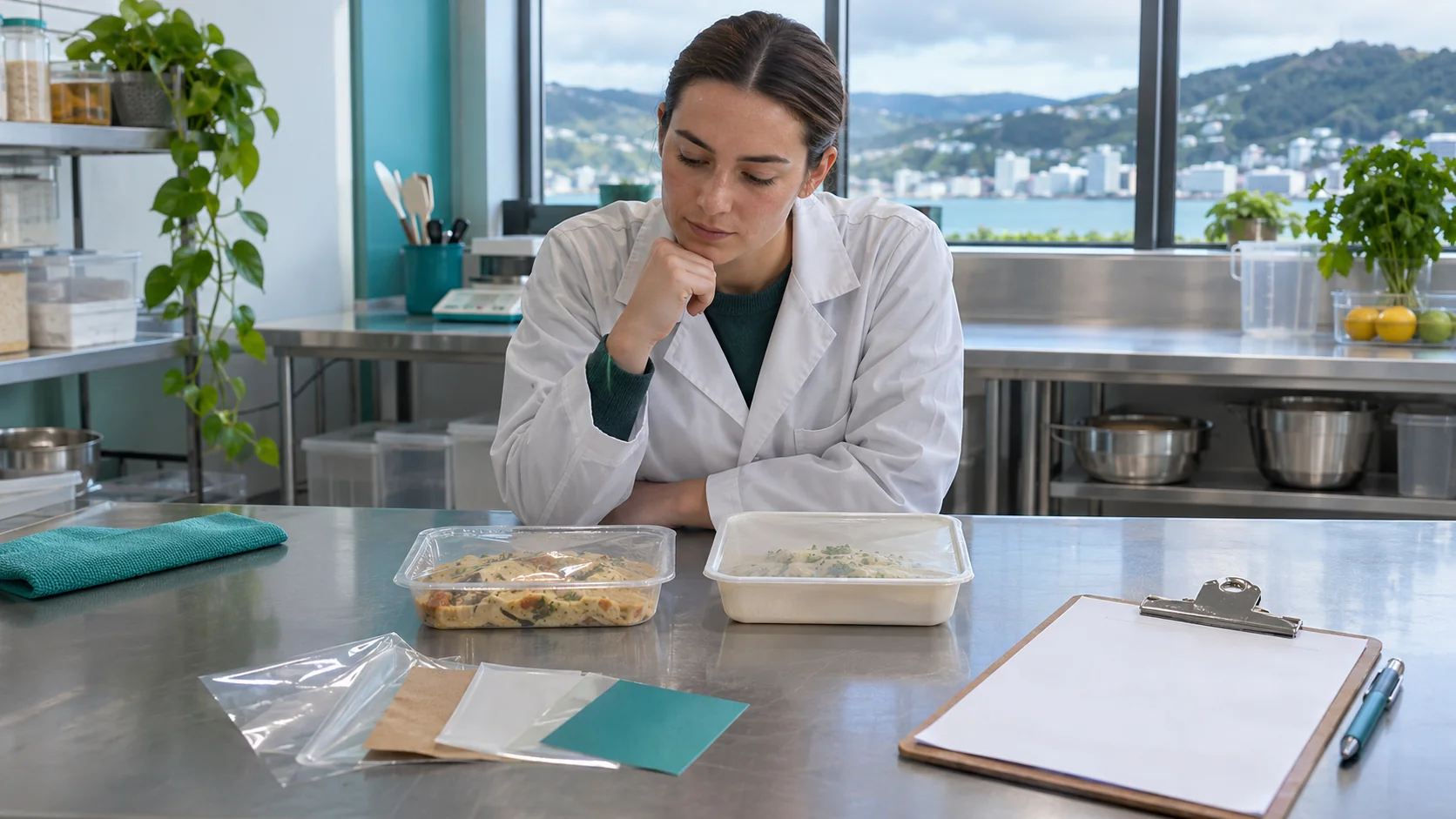
For example, a chilled dip maker replacing a tub should confirm the new lid and seal at normal line settings and compare the new pack with the conditions in the original study. If the closure performs differently, or the changed fill depth affects cooling, have the technical reviewer decide what further checks the product needs. Keep trial stock separate from released stock while the decision is open.
Record the release decision and update the right files
Give the decision an owner and record the versions, what changed, the evidence considered, the accepted storage conditions, the date mark and the first affected lot. Link the record to the product specification and the approved artwork or coding instruction. Ask the production and dispatch teams how they will tell old and new packs apart during changeover. If the change also affects a registered plan or a safety control, use your applicable change process. The HACCP change review guide covers that wider review.
For a changed product, check that the storage directions still support the date mark. FSANZ’s date-marking guidance explains when storage directions are needed. If you are considering changing dates already on stock, treat that as a separate decision and check the relevant requirements with MPI before altering the labels.
Frequently asked questions
Does every packaging change require a full shelf-life study?
The work depends on the change and on what your existing evidence covers. Compare the old and new pack in its intended use, document the technical basis for any equivalence and investigate differences that could affect safety or suitability.
Can I use a study from a product with a similar recipe?
Only rely on it where you can justify that its conditions and conclusions apply to your product and question. Check the formulation, process, final pack, intended storage and what the study actually measured.
Can we send one sample before making the first batch?
A sample can answer a defined question about that sample. Discuss whether the study needs production samples, multiple batches or several time points so that the evidence represents the product and storage conditions you intend to use.
How AFVA can help
Bring your current shelf-life summary, a before-and-after product specification and the proposed pack or process change. AFVA can help plan the assessment and review the evidence. Where testing is required, it is carried out by a suitable external laboratory.
General information only. Confirm the requirements that apply to your specific food activities, products, processes, locations and sales model.
Need Practical Food Safety Support for Your Business?
Contact us for free initial guidance. We provide practical, plain-English food safety support for New Zealand food businesses across all service areas.
This article provides general information only and is not a substitute for professional advice specific to your situation. Contact us for guidance based on your actual food activities and requirements.