
Need help with this food safety decision? Review AFVA’s food labelling review service or contact AFVA for free initial guidance.
A sulphites check starts before the artwork. A preservative may be added directly or arrive through a supplied ingredient, and the information needed for the finished food may be spread across recipes, specifications and laboratory reports.
This guide helps New Zealand food businesses organise that evidence for an added-sulphites declaration decision. It develops the sulphites entry in AFVA’s allergen labelling guide. Confirm the rules for the actual food and sales format, including any product-specific provision.
Quick answer. Added sulphites at 10 mg/kg or more in the food require declaration. Establish relevant sources, their contribution to the final formulation and the evidence supporting the concentration. Review the required sulphites declaration and any applicable food-additive listing together. Resolve uncertain calculations or results with a competent reviewer and suitable external laboratory before relying on them.
Identify the added sulphites behind the food label
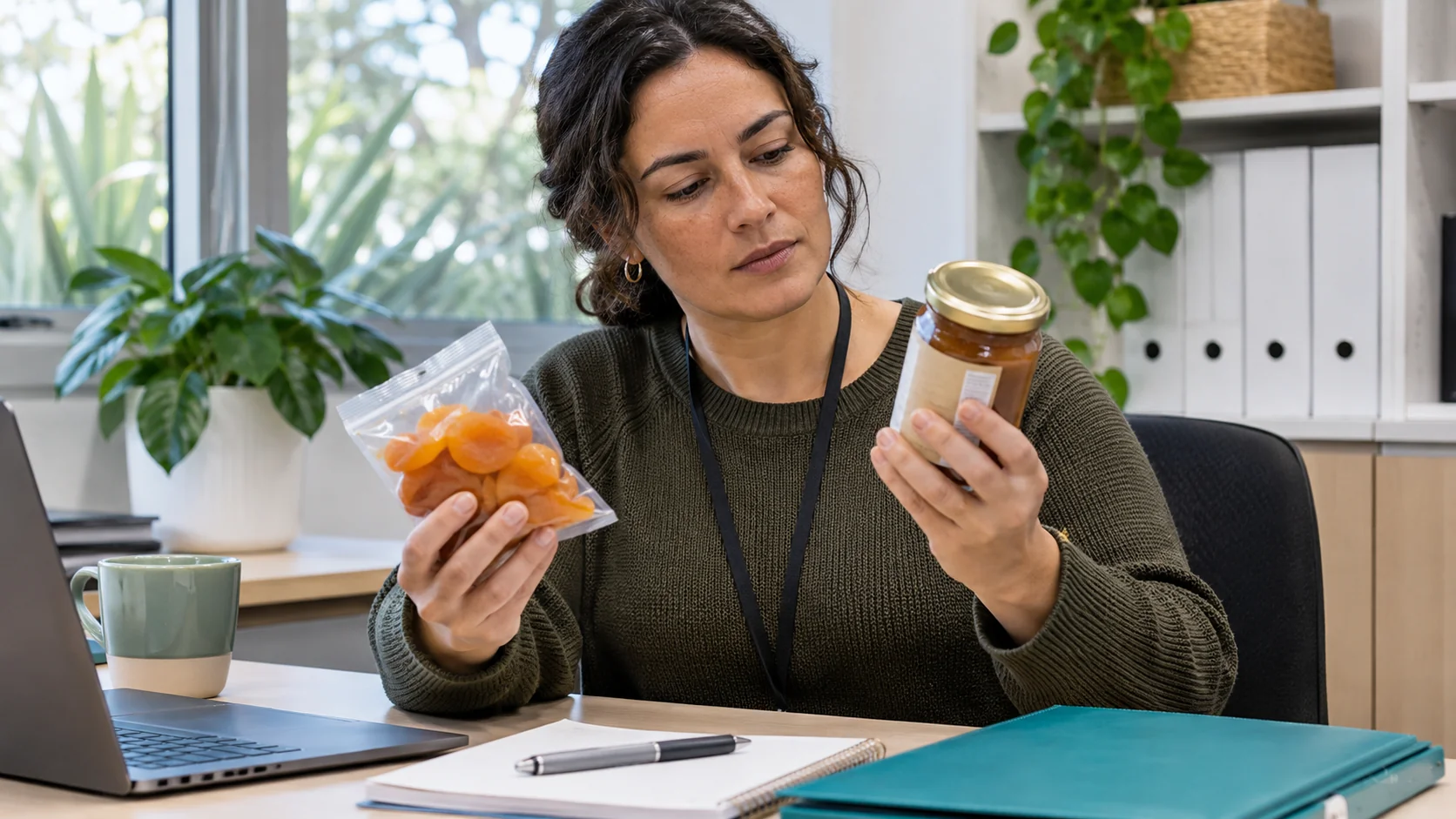
FSANZ’s sulphites guidance explains the declaration threshold for added sulphites. It lists foods such as dried fruit, cordials, sausages and wine as common examples. That list helps you recognise possible sources and does not determine the answer for a particular recipe.
Review ingredients that may carry a preservative, including compound ingredients. Ask suppliers for the current specification, the sulphite source, relevant concentration information and the basis on which it is expressed. Distinguish a measured value, a maximum specification and an estimate. Ask whether a statement relates to the supplied ingredient or your finished food.
Keep the exact supplier code and document version with the review. An ingredient described as unchanged may still come with a revised preservative specification. If information is missing, record the question and who will obtain it.
Connect ingredient data to the finished formulation
A supplier’s concentration is only one input. A reviewer also needs the quantity used, recipe units, process yield and any other relevant sulphite sources. Ask what processing or measurement assumptions affect the estimate and which conclusions the available information can support.
For a hypothetical arithmetic check, an ingredient used at 5% of the finished food with a stated 100 mg/kg concentration would contribute 5 mg/kg before considering other sources and process effects. This simple calculation demonstrates the units only. It does not establish the concentration, declaration decision or additive permission for a real product.
Adding results expressed on different bases can give a misleading answer. Confirm whether the supplier reports total sulphites as sulphur dioxide or another expression, and ask a competent reviewer to align the bases. Document uncertainties rather than turning an ingredient maximum into a precise finished-product result.
Questions for the evidence review
Evidence
Supplier specification
Confirm
Ingredient code, sulphite information, units, expression and version.
Unresolved question
Does this value describe the material actually supplied?
Evidence
Recipe calculation
Confirm
Ingredient proportions, all sources, finished yield and assumptions.
Unresolved question
Can these inputs support the final-food conclusion?
Evidence
Laboratory result
Confirm
Sample identity, method, reporting basis and relevant limitations.
Unresolved question
Can this result resolve the specific remaining uncertainty?
Order testing for a defined question
Testing can help resolve a question about the final food, but first explain the formulation and the decision to the laboratory. Confirm the appropriate method and matrix, result units and reporting limit. Ask how the result should be interpreted if it is close to a relevant threshold or reported below a measurement limit.
Choose samples that relate to the ingredient sources, production batches and process being assessed. A result for one submitted unit should remain connected to that unit and its limitations. Avoid assuming it covers all suppliers, recipes or future production. AFVA’s food testing guide explains how to define a testing brief.
Laboratory analysis is performed by an appropriate external laboratory. Agree what information the laboratory will provide and what assessment remains with the business or its label reviewer. Retain the original report and the reasoning used in the final review.
Check the declaration and ingredient listing together
Standard 1.2.3 contains the mandatory declaration requirements. FSANZ’s current allergen labelling guidance sets out required names and formatting. For food with an ingredient statement, declarations use the required name in bold within that statement and in the adjacent bold Contains summary, as applicable. Check the precise provisions for the food and package.
An additive’s class and name or number addresses another part of the label review. A preservative number alone does not communicate the required word sulphites. Similarly, a Contains statement does not complete every ingredient-list obligation. The food-additive labelling guide explains that separate review.
The 10 mg/kg declaration trigger is not a universal permitted-use limit. Confirm that any additive use is permitted for the specific food category and conditions. A voluntary may-contain statement cannot resolve missing evidence about an intentionally added source.
Keep the review usable when recipes or suppliers change
Before releasing artwork, link the reviewed supplier specifications, recipe, calculation, any reports and declaration wording to one product version. Record the reviewer, date, conclusion and limitations. Use AFVA’s label review information pack to organise the handover.
Suggested final checks include the following.
- Every possible added-sulphite source has been considered.
- Units and calculation bases are understood.
- The final food and relevant process match the evidence.
- The required word and format have been checked on the complete artwork.
- Additive permissions and ingredient listing have been considered separately.
- A change trigger identifies when the assessment needs review.
Common mistakes include looking only for an ingredient named sulphites, relying on an old specification, choosing a test before defining the question and treating the declaration threshold as permission to use the additive. Where the answer remains uncertain, identify the missing evidence before approving the label.
Frequently asked questions
What is the sulphites declaration threshold?
The Code requires declaration of added sulphites at concentrations of 10 mg/kg or more in the food. Check the relevant provisions and how the ingredient and concentration evidence apply to your actual product.
Can sulphites enter through a compound ingredient?
Include supplied ingredients and their components in the assessment. Ask for current information about any added sulphites and its reporting basis so the contribution can be reviewed with the recipe.
Is a preservative number sufficient?
Review the additive listing and mandatory declaration separately. The required sulphites name and applicable declaration format still need to be addressed. A number alone does not provide that name.
Does every sulphites review need a laboratory test?
Define the missing evidence first. Relevant supplier information and calculations may inform the assessment. Where analysis is needed, agree a suitable method, sample plan and interpretation with the external laboratory.
Does a result below 10 mg/kg prove every batch is below it?
A report describes the submitted sample under the method used. Review supplier and production variation, sampling and method limitations before applying the result more widely.
Can we use any amount below the declaration threshold?
Additive permission and declaration are separate questions. Check the permitted substance, food category, level and conditions that apply. The declaration threshold is not general permission for additive use.
How AFVA can help
Send AFVA your recipe, current supplier specifications, relevant reports and complete draft label. Ask for a review of the sulphites evidence and declaration within an agreed labelling brief. AFVA provides recommendations, with laboratory work arranged through an appropriate external laboratory where needed.
General information only. Confirm the requirements that apply to your specific food activities, products, processes, locations and sales model.
Need Practical Food Safety Support for Your Business?
Contact us for free initial guidance. We provide practical, plain-English food safety support for New Zealand food businesses across all service areas.
This article provides general information only and is not a substitute for professional advice specific to your situation. Contact us for guidance based on your actual food activities and requirements.