
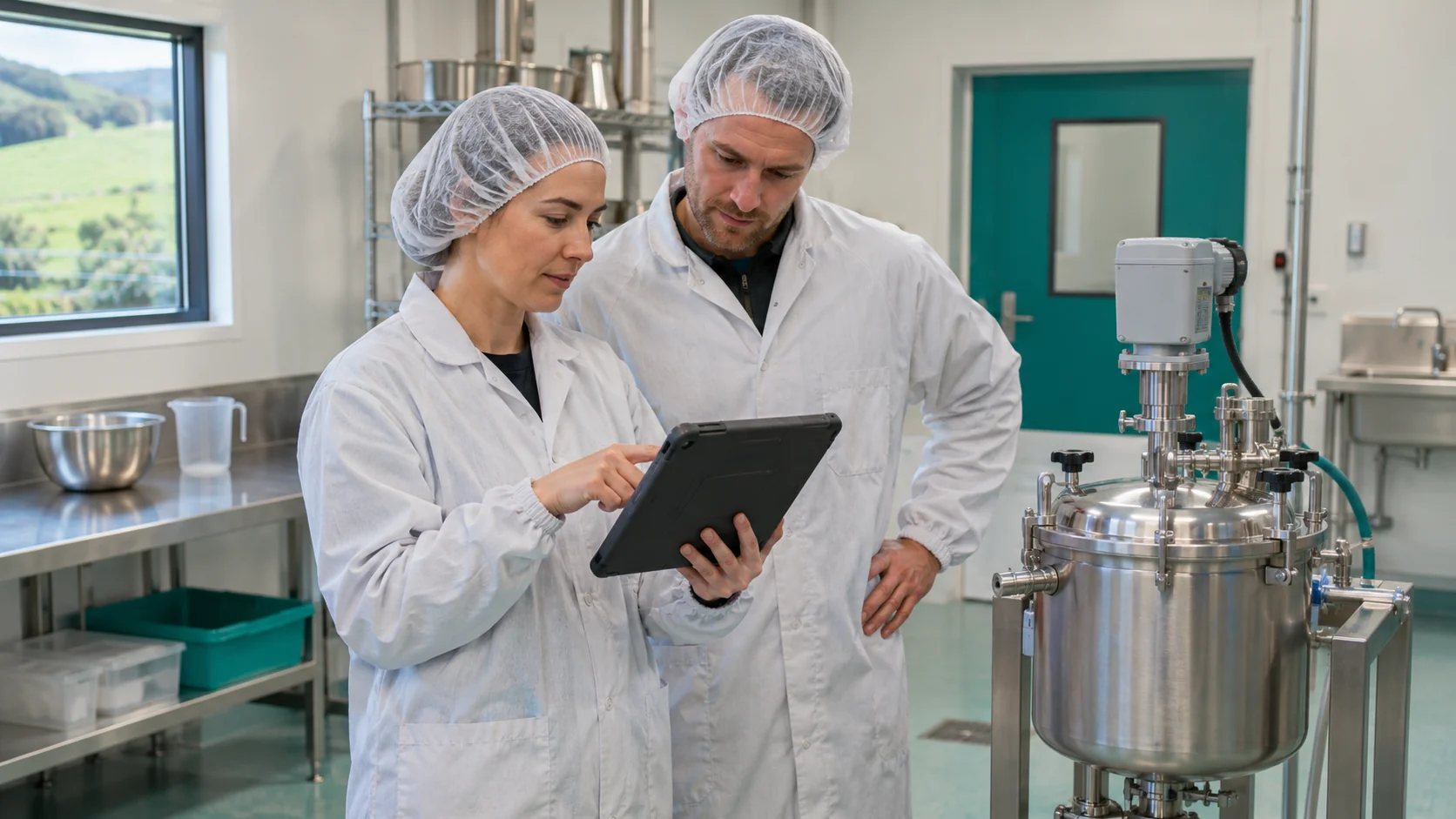
Need help with this food safety decision? Review AFVA’s new food product development support or contact AFVA for free initial guidance.
A product that works in a kitchen may behave differently when you change the mixer, batch size, filling line or pack. A pilot trial is a chance to see those differences before the first larger run ties up ingredients, packaging and production time.
This guide helps New Zealand food brands and manufacturers turn a prototype into a defined trial and make a documented decision about what should happen next.
Quick answer. Choose the decision the trial must inform, freeze the intended recipe and process versions, and agree the evidence and acceptance criteria before the run. Record what happened, including deviations and sample identities. Review what can carry over to commercial scale and what still needs testing or validation.
Give the pilot trial one main decision
Examples include whether the product will fill consistently into the proposed pack, whether a mixing change makes the texture repeatable or whether the new equipment can produce the intended process conditions. List food safety evidence and commercial quality targets separately so an attractive prototype does not settle an unresolved safety question.
Massey University’s FoodPilot describes pilot trials as a stage for refining formulations and processes and understanding product characteristics. The New Zealand Food Innovation Network describes pilot testing and scale-up services. Confirm suitability and scope directly with the facility if you plan to use one.
If you are still choosing which process to trial, start with AFVA’s food technologies comparison guide.
Send the operator a short trial sheet
Give the team a controlled version of the recipe, process sequence, batch size, raw material information and intended package. Specify the measurement points, instrument or method, sample plan and who may change settings. Agree the trial stock’s intended use and what to do if product or process evidence remains unresolved.
- Write the acceptance criteria, then identify which can be checked during the run and which depend on later sample results.
- Record ingredient and packaging versions, expected fill or pack details and any permitted substitutions.
- Record what to measure, where and when, and which test or comparison each sample supports.
- Set aside a way to identify, store and account for trial samples and stock.
- Document who owns the trial decision and the follow-up.
If you still need help specifying the product or defining the project, start with AFVA’s guide to briefing a food product development consultant.
Capture what actually happened on the line
Record the equipment used, batch ID, ingredient lots, actual quantities, key settings and changes from the planned sequence. Note the time and reason for each adjustment. Label each sample so you can connect its result to the recipe, process and packaging used. A test result is much less useful if the team cannot identify which fill, lot or setting it came from.
Illustrative example. A thicker sauce fills cleanly near the start of the run but becomes inconsistent after standing in the hopper. Record the time, relevant settings, fill observations and separately identified samples before making a decision. A trial note might read “Trial P03, samples P03-A and P03-B collected at startup and after the documented hold. Later fill inconsistent. Trial stock held for technical review.” Link that entry to the actual observations, sample labels and stock decision. A later trial might test a different process window under an agreed plan.
If another business will make the product, AFVA’s contract manufacturer selection guide covers the wider commercial and responsibility decisions.
Review what transfers to commercial production
Compare the commercial line with the pilot equipment, conditions and pack. Changes in geometry, agitation, load or dwell time can alter how the process works. Decide whether the next step is to repeat the trial, revise the design, collect further evidence or proceed to the next controlled stage. For a custom Food Control Plan, the MPI guide to evaluation and verification explains that appropriate validation evidence can vary and may include trials and data analysis. Confirm what evidence is needed for the actual food safety control with the appropriate specialist or evaluator.
Keep the conclusion short enough to use at the next production meeting. Name the product and version, what the trial supports, what remains uncertain, who is responsible and what must be resolved before the next decision. Update the finished food product specification when there is evidence and authority to adopt a change.
Frequently asked questions
Can a kitchen batch replace the pilot trial?
A kitchen batch can answer development questions. Decide which questions depend on the proposed equipment, batch size, packaging or actual production conditions, and plan evidence for those separately.
Does a successful pilot batch establish shelf life?
It can provide representative samples for an assessment if the design supports that use. Check the finished formula, process, pack, distribution and use assumptions when deciding what shelf-life evidence is needed.
What should I send a consultant after a trial?
Provide the trial objective, planned and actual versions, settings and deviations, sample IDs, any results and the decision you need to make.
How AFVA can help
Send AFVA the trial question, recipe and process versions, intended packaging, sample information and the evidence gaps that could delay scale-up. AFVA can discuss food safety, product specification, labelling and shelf-life planning support. Confirm separately who will run the trial and perform any testing.
General information only. Confirm the requirements that apply to your specific food activities, products, processes, locations and sales model.
Need Practical Food Safety Support for Your Business?
Contact us for free initial guidance. We provide practical, plain-English food safety support for New Zealand food businesses across all service areas.
This article provides general information only and is not a substitute for professional advice specific to your situation. Contact us for guidance based on your actual food activities and requirements.